


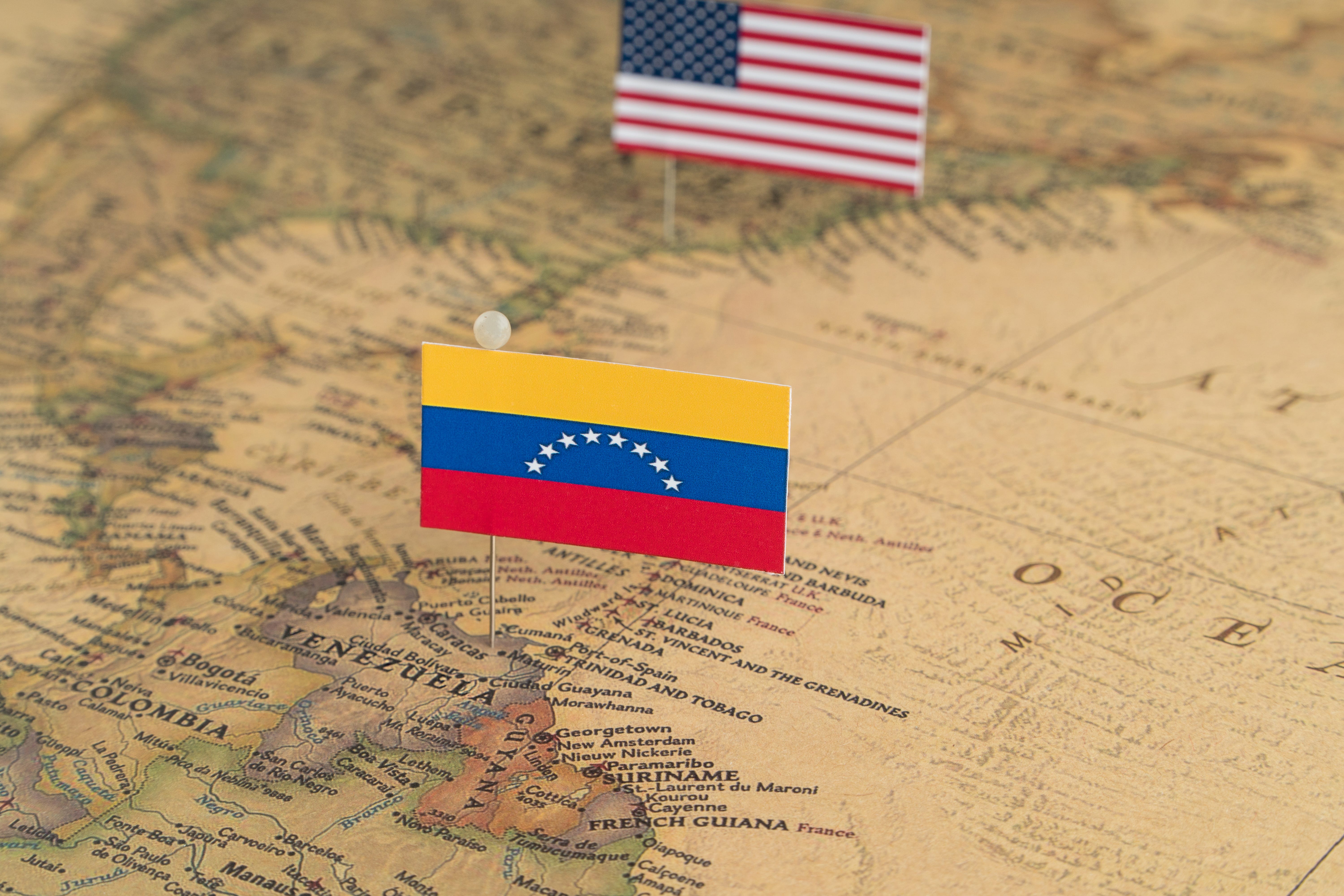
At first glance, Venezuela looks like noise.
The economics don’t make sense. The oil infrastructure is wrecked. Production capacity has collapsed. Corruption is endemic. Any serious attempt to extract durable value would require years of stabilization, billions in capital, and a political settlement no one involved appears interested in achieving. On a spreadsheet, “regime change for resources” is indefensible.
Which is exactly why it matters.
If the objective were oil (as the President claims), Venezuela would be a terrible choice. If the objective were profits—this fantasy that we’ll all be rich on “the deal”—it’s irrational. And if the objective were long-term strategic positioning, there are cleaner, cheaper, more reliable ways to get there.
So when the United States—under Donald Trump—turns its attention toward Venezuela, the mistake is to analyze the move as policy.
It isn’t. It’s posture.
Venezuela wasn’t chosen because it offers upside. It was chosen because it offers permission: permission to apply pressure without narrative discipline, to decouple action from outcome, and—critically—to test whether coercion can be exercised without paying immediate systemic penalties.
That is the tell.
For decades, American power operated inside performative constraints. Even when those constraints were violated—Vietnam, Iraq, Libya—the violations were wrapped in ritual: containment, humanitarian necessity, democracy promotion, stability operations. The rituals mattered even when the substance was thin, because they signaled that power still had to justify itself to allies, institutions, and domestic audiences.
Venezuela dispenses with the ritual.
There is no serious pretense of reconstruction. No articulated end state. No theory of governance. No explanation of what “success” looks like beyond vague promises of riches. “We run Venezuela” is not a governance claim; it’s a veto claim: the United States doesn’t need to administer the country if it can prevent anyone else from doing so.
That’s new.
Not new because great powers have never behaved this way—they have—but new because the United States largely avoided saying it out loud in the post-war era. The post-1945 order was not built on benevolence. It was built on self-restraint—or at least the appearance of it. American power was most effective when it looked bounded: alliances, institutions, soft power, persuasion. Even adversaries benefited from the predictability of restraint. That predictability is what made American dominance legitimate and what kept it out of the classic “great power overreach” trap.
That framework is fraying.
Venezuela signals a shift away from rule-bounded dominance toward coercive optionality—threats and pressure applied without a defined purpose beyond compliance in the moment. No settlement required. No legitimacy restored. Just leverage, exercised episodically wherever it seems easiest.
This is not imperialism in the classical sense. Empires administer. They tax, govern, stabilize, and extract over time. What is emerging instead is something older and more chaotic: pressure without stewardship, force without ownership, and coercion without accountability.
It is tempting to dismiss this as personality—a byproduct of Trump’s impulsiveness and contempt for process. That explanation is comforting, because it implies reversibility: remove the man, restore the norm.
Venezuela suggests something more durable.
The capacity to act this way did not appear overnight. It was built, layered, and normalized across administrations. The modern U.S. state possesses a mature toolkit designed precisely for coercion short of war: expansive sanctions authorities, emergency economic powers, export controls, visa and financial restrictions, security cooperation “reviews,” quietly reinterpreted basing and transit permissions, and broad national-security deference across courts and agencies. Much of this machinery operates at the speed of executive discretion and interagency process, not legislative debate.
None of this requires a declaration of war. Much of it barely requires public explanation.
This is what institutional permissiveness looks like. Not enthusiasm, but availability. Not conspiracy, but architecture. The system is designed to generate options faster than political oversight can meaningfully constrain them—and once options exist, the temptation to use them becomes the policy.
Trump didn’t invent coercion without ends. He simply stopped pretending it needed justification.
Which is why Venezuela matters more than it should.
It is a low-cost environment in which to test a dangerous proposition: that the United States can act as a raw coercive power without triggering immediate systemic consequences. No treaty obligations are directly triggered. No near-peer adversary is immediately engaged. No allied government is forced into a public confrontation. If there is backlash, it is manageable. If there is failure, it is deniable. And if there is success—however loosely defined—it reinforces the lesson that restraint is optional.
Once that lesson is learned, it doesn’t stay at the edge.
The danger is not that Venezuela becomes a template for endless interventions. The danger is that it becomes a precedent for permission—permission to threaten without settling, to escalate without resolving, and to move on without repairing what was broken. Moralizing about Trump misses the point. Systems do not care about virtue. They care about what becomes permissible.
And permissibility is seductive precisely because it feels cheap: no obligation to win, only to dominate momentarily; no responsibility to govern, only to coerce; no requirement to think through second- and third-order effects because the system, for now, isn’t forcing anyone to.
Professional practitioners of national security understand the game is long. They preserve optionality because second- and third-order effects always arrive eventually. But an administration oriented toward the present—toward what “feels good” in the moment—doesn’t price tomorrow. It spends legitimacy like it’s free.
History is unkind to powers that confuse the absence of immediate consequences with the absence of cost.
What Venezuela reveals is not a plan, but a reversion: a return to a world where force is used casually, legitimacy is an afterthought, and leaders assume escalation can be controlled by the side with the bigger guns. That assumption has been wrong before—twice catastrophically—and millions paid in blood for the arrogance of men who mistook dominance in one domain for mastery over all domains.
And once this belief is normalized, it stops being about Venezuela. It becomes about how the rest of the world recalibrates around an America that no longer feels bound to explain itself.
That recalibration is already underway.
And it is why this moment should not be waved off as noise.
The End of the Post-War Illusion
The most persistent mistake analysts make in moments like this is assuming the present is an aberration.
A norm has been violated. A taboo crossed. A guardrail ignored. Therefore, the familiar logic follows: discipline the violator, reaffirm the rule, restore equilibrium. Treat the event as noise, the system as intact, and the deviation as temporary.
That instinct fundamentally misunderstands what the so-called “post-1945 order” actually was—and how such orders decay.
The rules-based international system that defined the last eighty years among Western powers did not emerge because great states discovered virtue. It emerged because exhaustion, fear, and material devastation after the Second World War made restraint preferable, useful, and—critically—meaningful. Institutions were not expressions of idealism; they were technologies for managing power without repeating catastrophe.
Neoliberal institutionalist thinkers argued that cooperation arose because states, chastened by war, sought predictability under anarchy. That cooperation depended on a leader willing to bear disproportionate costs. The United States underwrote the system because it benefited most from stability; its partners cooperated because they wanted the same outcomes but were unwilling to pay the same freight.
The institutionalists were not entirely wrong. Where they erred was in assuming that once created, this arrangement would be self-sustaining.
The United States was the principal beneficiary of the system not because it followed the rules most faithfully, but because it had the most to lose from their collapse. Self-restraint was not altruism. It was strategy. Everyone else played along because cooperation delivered more benefits than obstruction.
For decades, American power was bounded not only by law, but by narrative discipline. When force was used, it was wrapped in justification—containment, deterrence, humanitarian necessity, stability operations. Even when those explanations rang hollow, their repetition mattered. They signaled that power still had to explain itself within a shared framework that allies, adversaries, markets, and institutions had invested in.
That framework is dissolving.
At this point, it is important to be precise about what has—and has not—changed.
I am not arguing that rhetoric equals execution, or that every threat implies imminent action. I argue that rhetoric, when repeated by a hegemon, alters the permission structure within institutions and the belief structure outside them. That is the signal.
International orders do not unravel only when tanks move. They unravel when categories of action that were previously unthinkable become discussable, plan-able, and defensible—first rhetorically, then bureaucratically, and only later operationally.
That is how option spaces expand.
When a president openly suggests that the only thing constraining American action is his own judgment and morality, that is not merely bluster. It is data. It is data about how power now understands its own limits. And it is data international-relations theory cannot ignore when institutions begin adjusting around it.
What Venezuela exposes is not the end of American power, but the end of America’s self-conception as a power that must justify its actions and remain accountable before acting. The operative question is no longer “is this legitimate?” but “can we do it?”
That shift is subtle—but profound.
Once force is treated as a discretionary tool rather than an exceptional one, accountability becomes optional. Treaties become preferences. Institutions become advisory. Allies are expected to adapt rather than object. The system stops constraining behavior and starts accommodating it.
This is not historically unprecedented.
Before 1914, Europe was not ignorant of risk. It was confident it could manage it. Great powers believed they understood escalation, that wars could remain limited, that prestige could be defended without catastrophe. They were wrong—not because they were irrational, but because they overestimated their ability to control complex systems under stress.
This is the lesson Barbara Tuchman captures in The Guns of August.
The parallel here is not one of personalities or ideologies, but of assumptions.
The assumption that force can be applied without cumulative consequences.
The assumption that credibility can be asserted without being tested.
The assumption that allies will absorb shocks quietly to preserve stability.
For a time, those assumptions held—until they didn’t.
When they failed, the consequences were catastrophic.
Venezuela fits this pattern precisely because it appears inconsequential. It does not immediately threaten alliance cohesion. It does not provoke a near-peer response. It does not require long-term administration. It feels contained.
But contained actions accrete.
Venezuela may prove, in retrospect, to be this century’s analogue to the assassination of Archduke Franz Ferdinand—not because it will trigger immediate war, but because it may mark the moment when assumptions about what was permissible quietly shifted. Catalytic does not mean causal. It means belief-changing.
Moments like this teach bureaucracies what is allowed. They teach allies what will be tolerated. They teach adversaries what to expect. And most dangerously, they teach decision-makers that escalation is cheap—until it suddenly isn’t.
This is why the claim that “nothing has really changed yet” is so dangerous. Systems rarely announce their failure at the moment of inflection. They continue to function imperfectly even as their internal logic decays.
The post-war order did not collapse when the first rule was broken. It collapses when rules are no longer required to justify violating them.
At that point, restraint is no longer structural. It becomes personal—dependent on the temperament and impulses of whoever happens to be in charge.
That is not stability. It is fragility masquerading as strength. And it was precisely the condition that preceded the First World War.
It is also the condition in which miscalculation becomes most likely—not because leaders are reckless, but because they believe they can always retreat later and avoid escalation.
History suggests otherwise.
Once power is unmoored from accountability or restraint, it does not become more effective. It becomes harder to predict. And unpredictability—not aggression—is what forces the rest of the world to recalibrate.
That recalibration—quiet, uneven, and already underway—is the real legacy of moments like Venezuela.
The question is no longer whether the post-war illusion can be restored.
It is how quickly the world adjusts to its absence.
It’s Not Just That Trump Is an Asshole
At this point, the temptation is to stop thinking and start moralizing.
Donald Trump is impulsive, vindictive, capricious, and constitutionally incapable of restraint. He treats institutions as inconveniences, allies as liabilities, and power as something to be exercised visibly and personally. In his worldview, politics is binary and zero-sum: for him to win, someone else must lose. None of this is in dispute, and pretending otherwise would be dishonest.
But stopping there is analytically fatal.
If the only explanation for Venezuela, Greenland, Canada, Australia, or Europe were that Trump is a uniquely malevolent or incompetent leader, the solution would be obvious: endure the term, replace the man, restore the norm. History resumes. The system snaps back into place.
This is the comforting story many people tell themselves. It is not supported by the evidence.
What Venezuela reveals is not merely presidential pathology, but institutional permissiveness. Trump did not create the capacity to act this way. He did not invent legal ambiguity, operational flexibility, or the bureaucratic muscle memory that makes coercion without ends possible.
He inherited them.
Trump’s defining trait is not creativity, but willingness. He is unusually prepared to walk paths others hesitate to take. But there is a difference between walking a path and building it. The uncomfortable truth is that the path was already there.
Nothing Trump has done in this domain required the international system—or America’s institutions—to break. It only required them to stop insisting on justification.
For decades, American power relied on self-imposed rituals. Decisions to use force were debated, laundered through process, and framed as exceptional. Those rituals did not always prevent abuse, but they imposed friction. They slowed action. They forced coordination. They created paper trails, accountability, and political cost. Presidents lost their jobs over these decisions. So did senior military officers and policy officials.
Trump has no interest in those rituals. More importantly, the system has discovered that it can function without them.
That discovery is the danger.
Once a bureaucracy learns it can absorb norm violations without immediate penalty—no treaty collapse, no market panic, no mass resignations—it internalizes a new baseline. Actions that were once unthinkable become “options.” Options become precedents. Precedents become background noise.
This is how institutional decay actually works: not through dramatic rupture, but through quiet accommodation.
This is also why focusing on Trump’s temperament alone misses the point. His volatility does not paralyze the system; it animates it. Loud, often absurd fixations force response. Contingency plans are drawn. Legal theories are stress-tested. Lines that once existed only in theory are crossed in practice.
Trump is a catalyst—but he is catalyzing a reaction that was already primed.
The system adapts by redirecting chaos rather than confronting it. Trump supplies unpredictability. The machinery supplies continuity. What emerges is not coherent strategy, but accidental functionality: power exercised where it is easiest, cheapest, and least likely to provoke immediate backlash.
Venezuela fits this pattern perfectly.
It is peripheral enough to avoid existential escalation, yet significant enough to test whether the United States can apply coercion without paying institutional costs. It allows the system to explore a dangerous proposition: that force can be used episodically, without defined objectives, without accountability, and without long-term ownership.
So far, the answer has been yes.
That answer will not be unlearned simply because Trump eventually leaves office.
This is the part many observers still resist. A more disciplined, rhetorically competent successor would inherit a system in which the threshold has already moved. Once institutions learn that restraint is optional, re-imposing it is far harder than abandoning it.
Norms are easy to melt and hard to refreeze.
This is why the claim that “the adults will rein him in” misses the point. They are not restraining him in the way people imagine. They are managing around him—absorbing shocks, rerouting pressure, and preserving system functionality at the cost of norm integrity.
That tradeoff feels rational in the short term. It is corrosive in the long term.
The result is a form of power that is neither fully intentional nor fully constrained. Coercion happens not because it is part of a grand design, but because nothing reliably stops it. Accountability erodes not through conspiracy, but through habituation.
In that environment, asking whether Trump is “right” or “wrong” misses the operative question.
The real question is whether the United States still believes it must explain itself before it acts.
Venezuela suggests that answer is no.
And once that belief is gone, it no longer matters whether the person in charge is crude or polished, impulsive or disciplined. The system has already learned it can move first and rationalize later.
That is not a Trump problem.
It is a structural one.
And it is why the rest of the world is recalibrating—not around a single presidency, but around the possibility that American restraint is no longer a given.
Why Greenland Became the Symbol
If Venezuela was the tell, Greenland is the misdirection.
To most observers, the fixation looks absurd. Greenland is sparsely populated, inhospitable, politically peripheral, and already embedded within the Western alliance structure. Any serious attempt to seize it by force would be strategically incoherent, diplomatically catastrophic, and operationally unnecessary. On its face, the idea borders on farce.
Which is precisely why it matters.
Greenland is not important because it is likely to be invaded. It is important because it is being discussed seriously at all.
For decades, certain categories of action were simply excluded from the menu of legitimate options—not because they were impossible, but because contemplating them openly would have shattered foundational assumptions. Allied territory was one such category. The taboo was not military weakness; it was conceptual restraint.
Greenland breaks that taboo.
The repeated public discussion of Greenland—whether framed as purchase, security necessity, or strategic inevitability—does something subtle but corrosive. It normalizes the idea that all assets are negotiable, even those embedded in alliance structures once thought sacrosanct. It shifts the question from “should this even be discussed?” to “under what terms might it occur?”
That shift is the point.
Greenland functions as a symbolic stress test. It forces institutions, allies, and publics to confront a destabilizing proposition: that alignment does not confer immunity, and that even treaty-bound relationships may be subject to renegotiation under pressure. The value of the exercise lies not in execution, but in exposure—exposure of how far assumptions have already moved.
This is why arguments about whether NATO would respond militarily miss the mark. The test is not whether European governments would fight the United States. They almost certainly would not. The test is whether European governments continue to assume American restraint as a structural constant when planning their own risk exposure.
Once that assumption weakens, everything else changes.
By definition, early-stage recalibration does not surface as public policy. It appears first as internal friction—slower approvals, conditional cooperation, expanded review processes, and the quiet replacement of default yeses with discretionary maybes.
Recalibration does not begin with speeches, votes, or dramatic confrontations. It begins with friction.
It shows up in:
more conditional basing and transit permissions
increased use of “review” mechanisms for security cooperation
tighter rules around intelligence sharing and compartmentalization
greater domestic political scrutiny over hosting U.S. personnel or assets
more hedging language in defense planning and contingency documents
These are not headline events. They are bureaucratic events. And bureaucratic events are how alliances degrade long before they formally break.
Greenland also reveals something essential about how coercion now operates. It is not aimed first at adversaries, but at boundaries—between ally and target, between cooperation and compliance, between norm and option. By pushing against those boundaries rhetorically, the system learns how much resistance exists before force is even contemplated.
This is why Greenland generates so much outrage and so little clarity. Outrage signals that a line is being touched. The absence of meaningful consequences teaches the lesson.
Importantly, none of this requires the president to be rational in any conventional sense. Fixation alone is sufficient. Repetition forces response. Response forces internal planning. Planning transforms the unthinkable into a contingency. And once a contingency exists, the threshold has already moved.
Greenland is useful precisely because it is constrained. It sits inside the alliance, implicates multiple partners, and would generate immediate second- and third-order effects if acted upon. That makes it an ideal upper-bound test: a way to see how far rhetoric and pressure can go before the system pushes back in a way that imposes real cost.
So far, the pushback has been rhetorical, procedural, and symbolic—but not prohibitive.
That outcome matters more than whether anything ever happens in Greenland itself.
In this sense, Greenland is less about territorial ambition than about psychological jurisdiction. It tests whether American power is still understood as bounded by prior commitments, or whether those commitments are now merely inputs into negotiation. Increasingly, the answer appears to be the latter.
This is also why Greenland dominates headlines while other, more operationally significant targets remain unspoken. Loud fixation absorbs attention. It conditions observers to think in extremes. And it allows quieter forms of coercion elsewhere to proceed with less scrutiny.
Greenland is the map-sized object that keeps everyone looking in the wrong direction.
The real danger is not that Greenland is taken. It is that contemplating it teaches every actor involved—bureaucrats, allies, adversaries—that nothing is categorically off-limits anymore. Once that lesson is internalized, restraint stops being a rule and becomes a choice.
And choices, unlike rules, vary by circumstance.
That is why Greenland matters even if it never changes hands. It marks the point at which the difference between ally and asset becomes negotiable—at least in theory. And in international politics, theory has a way of becoming practice once enough people start planning for it.
The fixation, then, is not madness.
It is disclosure.
It reveals how far the conceptual ground has already shifted—and how much of the post-war order depended not on enforcement, but on a shared refusal to ask certain questions out loud.
Those questions are now being asked.
The world is adjusting accordingly.
The Real Targets Are Quieter
If Greenland is the symbol, it is not the model.
One of the most persistent errors in contemporary analysis is assuming that the loudest threat marks the most likely action. In practice, coercive power is most effective where it attracts the least attention, provokes the least resistance, and can be justified as technical rather than political.
That is where the real targets sit.
What Venezuela and Greenland together reveal is not a renewed taste for conquest, but a preference for leverage without ownership. The objective is not to administer territory, rebuild states, or assume responsibility for outcomes. The objective is compliance—episodic, deniable, and revocable.
That narrows the field considerably.
Targets selected under this logic share a common profile. They are structurally important but politically peripheral; dependent but not protected; exposed to pressure but poorly positioned to escalate. They sit at chokepoints—financial, logistical, regulatory—where disruption can be framed as enforcement rather than aggression.
This is why fixation on invasion scenarios is misplaced. The modern exercise of power rarely begins with troops.
It begins with rules.
Regulatory scrutiny.
Financial compliance.
Security cooperation “reviews.”
Sanctions threatened but not fully imposed.
Market access conditioned on alignment.
None of this requires a declaration of intent. None of it violates international law in a way that produces immediate rupture. And all of it is extraordinarily effective.
Panama is illustrative—not because it is uniquely vulnerable, but because it demonstrates the model. Control over transit, shipping, insurance, banking, and security regimes confers leverage far out of proportion to territorial size. Pressure can be applied quietly, justified bureaucratically, and reversed selectively.
The point is not that the United States needs the Panama Canal for every shipment. The point is that chokepoints retain power symbolically and administratively even when they are not strictly indispensable. Leverage operates as much through perception, compliance regimes, and discretionary enforcement as through physical necessity.
No occupation is required.
No flags are raised.
No shots are fired.
The same logic applies elsewhere. Small and mid-sized states embedded in global flows—trade hubs, financial conduits, logistics nodes, data corridors—are more exposed than large, politically volatile countries that dominate headlines. The former can be squeezed quietly; the latter generate resistance, backlash, and cost.
This is why some places that appear “safe” under traditional geopolitical analysis are becoming more fragile, while others that look unstable remain relatively insulated. Stability is no longer about internal order alone. It is about exposure to leverage.
Equally important is what this logic avoids.
Near-peer competitors are costly.
Formal allies are entangled.
Large states are noisy and resistant.
The path of least resistance runs elsewhere—through jurisdictions where pressure can be applied incrementally, bureaucratically, and with plausible deniability. This is not weakness. It is efficiency.
Once understood, the pattern becomes obvious. Loud rhetoric is used to test boundaries and shift expectations. Quiet action is used to extract results. The two are not contradictory; they are complementary.
This is why watching speeches, tweets, or press conferences tells you very little about where pressure will actually be applied. By the time a target is named publicly, it has usually already become expensive.
The more reliable indicator is bureaucratic motion: reviews initiated, standards revised, compliance regimes tightened, cooperation “re-evaluated.” These are the early warning signs of coercion in a system that prefers deniability to spectacle.
And this is where the individual-level implications become unavoidable.
Quiet coercion does not primarily target populations. It targets administrative systems. It works by changing how rules are applied, how discretion is exercised, and how foreigners are classified. Visas, banking access, tax treatment, residency renewals, corporate compliance, and “enhanced due diligence” regimes are not side effects of this system. They are core instruments.
For individuals and firms—and especially for those contemplating relocation or second residency—risk is no longer concentrated where violence is most visible. It accumulates where rules can be changed quietly and where permissions can be withdrawn without explanation.
This is why so much contemporary analysis feels off. It remains anchored to a world where power announced itself loudly and escalation was linear. That world is gone.
What replaces it is not chaos, but something more subtle and more pervasive: a system in which pressure is continuous, outcomes are provisional, and nothing is ever quite settled. Targets are not conquered; they are managed. Compliance is not permanent; it is renewed.
In that environment, safety is not a function of neutrality, ideology, or distance from conflict zones. It is a function of how exposed you are to someone else’s discretion.
Greenland grabs attention because it feels outrageous. But the real lesson lies elsewhere—in the quiet places where pressure can be applied without headlines, and where resistance is measured not in tanks, but in paperwork.
That is where the next phase unfolds.
And it is why, for those paying attention, the relevant question is no longer “where might America act next?”
It is “where can pressure be applied without anyone feeling compelled to stop it—and who will bear the administrative cost when it is?”
Coercion Without Ends
The most important feature of the current moment is not aggression.
It is indeterminacy.
What is emerging is not a return to classical imperialism, nor a coherent strategy of expansion. It is something more corrosive: the routine application of pressure without a defined political end state. Coercion becomes a tool of management rather than a means to resolution.
This is a fundamental shift.
Historically, force—even when abused—was oriented toward outcomes. Territory was seized to be governed. Regimes were overthrown to be replaced. Wars were fought to end something: a conflict, a balance, a threat. Ends may have been ill-defined or dishonest, but they existed.
What we are seeing now is coercion without ends.
Pressure is applied not to settle disputes, but to extract compliance in the moment. Threats are issued not to change the system, but to remind others who can disrupt it. Actions are taken without any obligation to stabilize what follows, because stabilization is no longer the objective.
This matters because systems behave very differently when no end state exists.
Without an end state, there is:
no stopping rule
no success condition
no moment at which restraint must be reimposed
Escalation becomes episodic rather than linear. Pressure is turned on and off, redirected, reapplied elsewhere. Outcomes remain provisional. Compliance is temporary by design.
From a narrow tactical perspective, this can feel efficient. It avoids the costs of occupation, governance, and reconstruction. It preserves flexibility. It allows power to be exercised without ownership.
From a systemic perspective, it is deeply destabilizing.
When actors cannot infer what ends are being pursued, they cannot reliably de-escalate. When pressure has no terminus, every concession becomes suspect and every compromise provisional. The incentive shifts from cooperation to hedging, from alignment to insulation.
This is where neoliberal institutional logic finally breaks.
Institutions work by reducing uncertainty. They function because participants can form expectations about behavior over time. Coercion without ends destroys that expectation space. It replaces predictability with discretion.
Once discretion becomes the norm, institutions stop constraining power and start serving as venues for pressure. Rules are no longer guardrails; they become tools—interpreted, bent, or selectively enforced.
The result is not chaos, but something worse: permanent provisionality.
Nothing is settled.
No agreement is final.
No alignment is secure.
Every relationship becomes subject to renegotiation under the threat of disruption.
This is why the world begins to feel brittle even in the absence of open conflict. Stability depends not on shared rules, but on the temperament and attention span of whoever is applying pressure. That is not a stable equilibrium. It is a rolling crisis held together by inertia.
For allies, this creates an impossible position. Compliance today offers no protection tomorrow. Resistance risks immediate punishment. The rational response is neither loyalty nor defiance, but diversification: reduce exposure, build redundancy, quietly prepare for decoupling.
For adversaries, coercion without ends is clarifying. If pressure is applied regardless of behavior, restraint offers no protection. Hardening becomes rational.
And for individuals—especially those whose legal status, residency, or mobility depends on institutional stability—the implications are direct. Systems built to administer predictable rules struggle under discretionary pressure. Bureaucracies respond by narrowing eligibility, increasing scrutiny, and reclaiming discretion wherever possible.
This is how geopolitical behavior translates into administrative reality.
No declaration is required.
No policy announcement is necessary.
The shift occurs through accumulated micro-decisions made in anticipation of volatility.
Coercion without ends does not produce dramatic collapse. It produces ambient insecurity. People, firms, and states begin acting as if tomorrow’s rules may not resemble today’s. Long-term planning shortens. Commitments become conditional. Trust erodes quietly.
This is the environment now taking shape—not because war is inevitable, and not because any single move is decisive, but because once pressure is untethered from resolution, the burden of adjustment shifts onto everyone else.
The powerful retain optionality.
Everyone else absorbs uncertainty.
That asymmetry is the defining feature of the current phase.
And it is why the consequences of this moment will not be measured primarily in territory gained or lost, but in how quickly actors across the system begin planning for a world where nothing ever quite settles.
So What Does This Mean — Now
At some point, analysis stops being clarifying and starts being evasive.
The purpose of this piece is not to convince you that Venezuela is “bad,” or that American power has suddenly become malevolent. The purpose is simpler and more uncomfortable: Venezuela is signal, not noise. It marks a shift in how power is exercised, constrained, and justified—and that shift materially changes the environment in which personal and institutional decisions are made.
This is not about prediction. It is about re-pricing assumptions.
The relevant questions are no longer whether the post-war order can be restored, whether American restraint will reassert itself, or whether this phase proves temporary. Those questions may be intellectually interesting. They are no longer decision-relevant.
What matters is this:
The assumptions that made waiting safe are gone.
In an environment defined by coercion without ends, unpredictability is not a passing phase. It is the operating baseline. Rules still exist, but they are applied with increasing discretion. Institutions still function, but defensively and unevenly. Permissions are granted narrowly, reviewed frequently, and revoked quietly.
This is not collapse.
It is administrative hardening.
And administrative hardening is exactly how discretionary systems express power without drama. You don’t get announcements. You get delays. You don’t get bans. You get “reviews.” You don’t get prohibitions. You get denials without explanation.
For individuals, this produces a simple but uncomfortable implication: mobility is no longer something you plan when it feels convenient. It is something you secure while the system is still permissive enough to allow it.
We are early in this story—but it is accelerating.
The people who get caught flat-footed in transitions like this are not the reckless. They are the patient. The ones waiting for confirmation. The ones assuming the window will announce itself before it closes.
It won’t.
Windows close bureaucratically, not dramatically. Processing times lengthen. Standards tighten. Discretion expands. What was once routine becomes exceptional. And by the time the change is obvious, the queue has already formed behind you.
This is why the correct response to moments like this is not panic, but compression.
Compression of timelines.
Compression of assumptions.
Compression of optionality into reality.
This is also where the distinction between “leaving” and “hedging” finally becomes clear.
This is not an argument against domestic engagement, political participation, or trying to improve conditions at home. It is an argument against single-point-of-failure dependency. When systems become discretionary—when access, status, and rights depend increasingly on interpretation rather than rule—the rational response is diversification.
States hedge. Firms hedge. Capital hedges.
So do people.
Relocation, residency, and second citizenship are no longer lifestyle optimizations. They are risk mitigations. They are not statements about where you “belong.” They are acknowledgments of how exposed you are willing to remain when discretion replaces predictability.
None of this requires certainty about what comes next. In fact, the absence of certainty is the signal.
When systems become discretionary, early movers pay less—in money, scrutiny, and stress. Late movers pay more, and often discover that what they believed was a right was only ever a permission.
This is the part most people resist. They want a forecast. A date. A trigger event. Something that tells them when action becomes justified.
That is not how structural shifts work.
They reveal themselves not through catastrophe, but through accumulation—the steady erosion of the conditions that once made inaction safe.
That erosion is now visible.
So if the question is “where does this end?” the honest answer is that it doesn’t end cleanly. It resolves into a new normal: stability that is conditional, access that is discretionary, and mobility that increasingly favors those who prepared early.
The purpose of seeing this clearly is not to argue with it.
It is to act before acting becomes expensive.
The next piece will address how.
A moment of your time:
Borderless Living isn’t commentary. It’s decision intelligence for people who understand that systems fail quietly long before they fail publicly.
Paid subscribers get access to:
forward-looking geopolitical risk analysis
country and residency evaluations through a sovereign-architecture lens
decision frameworks for mobility, citizenship, and capital positioning
If you’re still relying on mainstream narratives, stay free.
The paid side of Borderless Living is where signals like this are translated into action—what to do, where to move, and how to structure optionality before windows narrow.
If you’re waiting for certainty, don’t subscribe.
If you’re acting on early signals, you already know why you’re here.
Either way, thanks for reading.
The visa, the apostilles, the background check — those are the easy part. People get all of that right and still end up in trouble. Even people with accountants, lawyers, and wealth managers.
What goes wrong is further back. A decision that looked perfect ten moves ago, arriving now as a tax bill, a letter from a government, a check you didn’t plan to write. And nobody had to do anything wrong. They just never saw the whole board.
A Situation Review takes 25 minutes. It’s free. You’ll leave knowing whether you have a wish or a plan.
I basically agree with the analysis, but way too repetitive and long. Also, I don't discount the possibility that Trump might actually want to take Greenland by force. He is clearly certifiable at this point. I'm wondering how our military would respond to such orders. It would clearly be an illegal order, but I'm not confident they would refuse to do it.
Excellent, if a very long read. All your insights and analyses seem correct. All the tiny trickles have merged and grown into a roiling flood, and replacing Trump will not end it. Sad.