



If you’ve been watching the news this week, the temptation is understandable.
Iran. Missiles. Shipping lanes closing. Oil markets going vertical.
Whenever something like this happens, a predictable reaction appears in my inbox.
“Maybe it’s time to get out.”
Move abroad. Get a second passport. Open an offshore account. Put some distance between yourself and whatever madness seems to be accelerating around you.
That instinct is not irrational. But most people acting on it are thinking about the problem completely backwards.
The Fantasy Version
In the fantasy version of this plan, you decide things are deteriorating, pick a country that seems attractive, buy a plane ticket, rent an apartment, and start a new life somewhere that feels calmer and more stable.
It’s a nice idea.
It’s also mostly fiction.
Because the modern world has quietly built an extraordinary amount of friction into exactly those kinds of moves. Residency rules. Tax treaties. Banking regulations. Capital reporting laws. Citizenship restrictions. Financial compliance regimes that follow you across borders whether you realize it or not.
Most people only discover those realities after they’ve already tried to execute the plan.
And by then the mistakes are often expensive. Sometimes very expensive.
The Half-Cocked Version
The other common approach: someone reads a few articles, watches a few YouTube videos, decides they understand how international mobility works.
They wire money somewhere. Set up a foreign entity. Maybe buy property in a country they’ve never lived in. All with the vague idea that they are “diversifying” or “going global.”
Six months later they discover they’ve created a tax nightmare. Or violated a reporting rule. Or built a financial structure that looks clever on the internet but collapses the moment a regulator looks at it closely.
International planning is one of those areas where partial knowledge is frequently worse than ignorance.
The system you’re trying to navigate is designed by governments that are not particularly enthusiastic about people escaping their jurisdictional gravity.
The Real Question
So when readers write and ask: “Should I be thinking about leaving?”
My answer is usually the same.
You’re asking the wrong question.
The question is not whether you should move abroad. The question is whether you have built any meaningful flexibility into your life at all — and most people don’t understand what that actually requires.
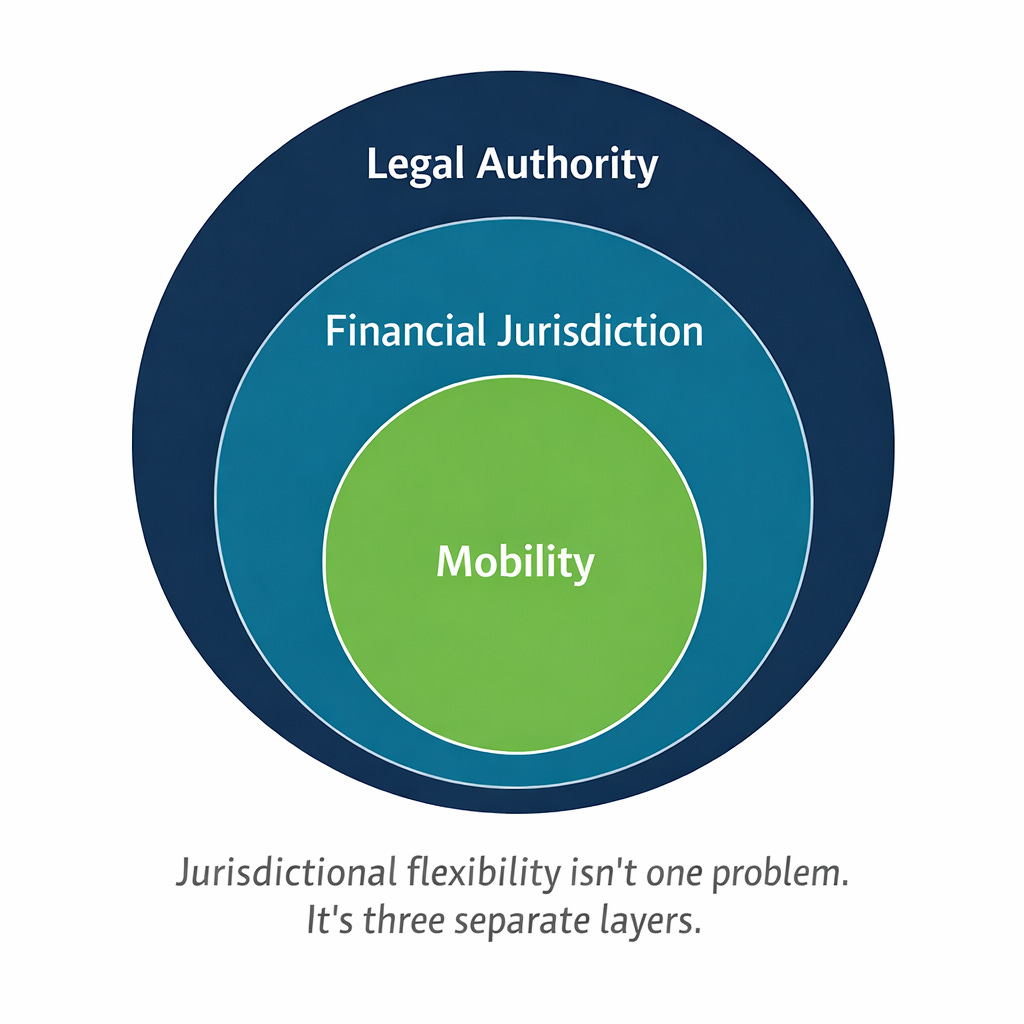
Because jurisdictional flexibility is not one problem. It is three separate problems — and most people only attempt to solve one of them.
The Timing Problem
The moment when people start asking these questions is almost always the wrong one.
They start during the crisis. But the systems that govern international mobility — visas, banking relationships, tax structures — do not move at crisis speed. They move at bureaucratic speed.
Months. Years. Occasionally decades.
Which means that when people suddenly decide they need options outside a single jurisdiction, the window to create those options is often already closing.
And the uncomfortable reality is that most people who try to solve this problem during a crisis discover something worse than friction:
They were solving the wrong problem entirely.
What they needed wasn’t a move. It was an architecture.
And architecture has to be built before you need it — because the three problems that actually constitute jurisdictional flexibility take time, sequencing, and expertise that no amount of panic can compress.
Here’s what those three problems actually are.