



If you are self-employed in the United States and you are under 65, you are paying somewhere between $1,800 and $2,500 a month for health insurance (health, vision, and dental) for a family of four. You know this. You’ve made your peace with it, or you haven’t, but either way, the money leaves the account every month.
In exchange, you have a deductible — probably somewhere between $6,500 and $9,000 per person — which means that the insurance you’re paying for doesn’t actually start paying for much until your family has spent the out-of-pocket. If you have something like Blue Cross, it’s a coinsurance arrangement, and you’re paying while the insurance pays (you usually pay more). This is by design. You are not a patient to this system. You are a revenue stream.
And let’s say you’re not self-insuring through your own enterprise. Let’s assume you work for someone else. The numbers don’t change; they just burden-shift, because whether you realize it or not, you’re paying for all of your health insurance, not your employer. Your employer will pay some percentage, and you will have a percentage deducted from your paycheck. The same screwball system of deductibles and out-of-pocket still applies.
Maybe you’re retired. Then you already know the version of this story where people in their seventies are driving gig-economy shifts to cover what their coverage doesn’t.
It’s really not a pretty picture, regardless.
I want to tell you what healthcare costs could look like when you leave.
Let’s put a real number on the American problem first.
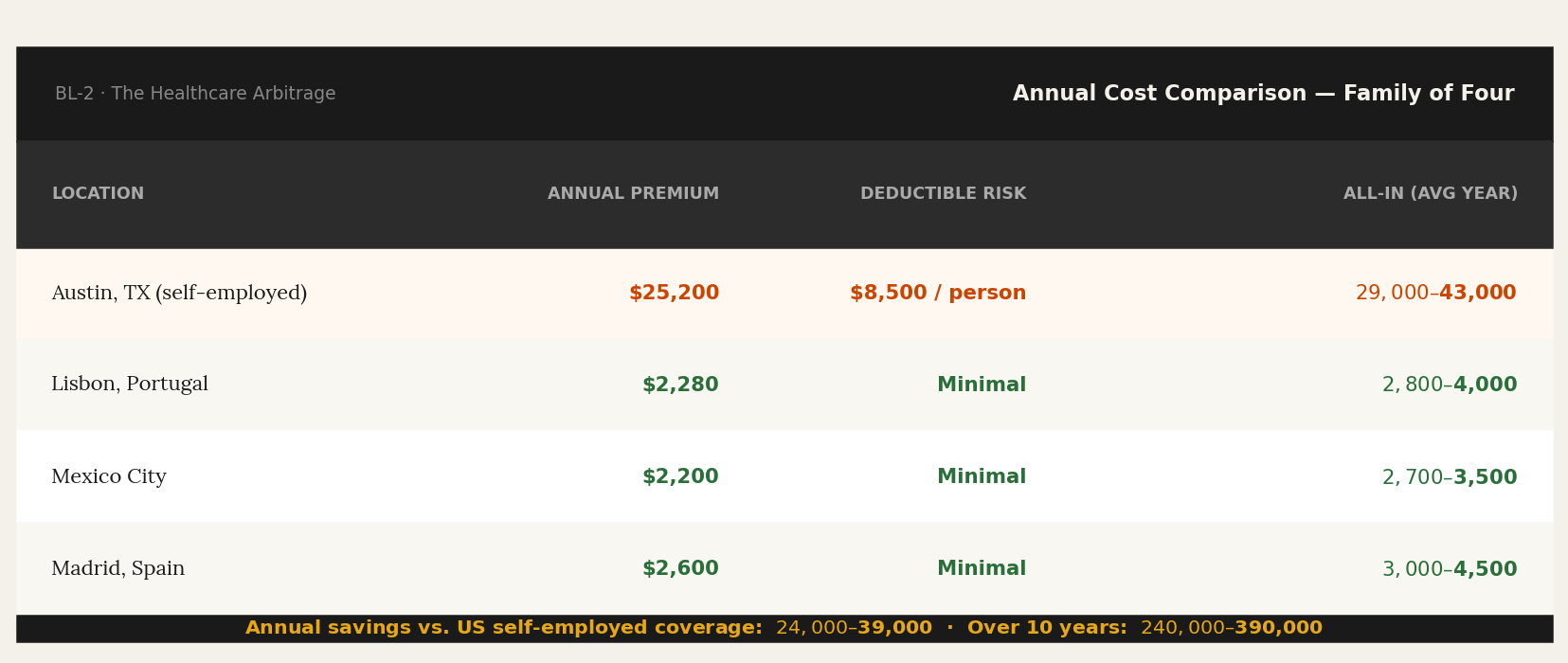
A self-employed couple, both 42, with two kids. ACA marketplace, silver plan, family coverage. In most US metro markets in 2026, premiums are approximately $2,100 per month. Annual premium cost: $25,200. Family deductible before meaningful coverage: $8,500. Out-of-pocket maximum: $18,000.
In a year with any significant medical event — a surgery, a hospitalization, a serious diagnosis — this family can spend $43,200 in premiums and out-of-pocket costs before the insurance actually provides what most people in the rest of the developed world consider “basic coverage.”
In a year without major events, they spend $25,200 plus whatever routine care costs below the deductible.
That is the baseline. Now here’s the comparison.
Portugal.
A private comprehensive family health plan in Portugal — covering GP visits, specialist access, diagnostics, hospitalizations, prescription drugs — runs approximately €150–200 a month for a family of four. Call it €175, or about $190 a month.
There is no meaningful deductible. GP visits have a small copay (€5–15). Specialists charge €30–80 for a private consultation. Emergency care at a private hospital: €100–200 for the visit, more for procedures.
Annual cost: approximately $2,280.
Versus the American baseline above: you’re saving $22,920 a year in premiums alone, before accounting for the deductible structure you’ve escaped.
Mexico.
Mexico has a two-track healthcare system. It’s changing, but for now, I’m going to deal with the system as it presently is, not what it will be just yet (it is getting better, so this story only improves). The public system (IMSS) has a voluntary affiliation option for foreigners — an annual cost of approximately $600–700. Private healthcare in Mexico City, Guadalajara, and the major expat hubs is world-class for most conditions and costs a fraction of what it does in the US.
A private supplement plan covering specialist care, hospitalizations, and major procedures: $1,500–2,000 a year.
Total annual healthcare cost for the same family: approximately $2,200–2,700.
GP visit at a private clinic: $25–50. Specialist consultation: $50–100. An MRI, out-of-pocket: $200–400. I have spoken to people who’ve had MRIs in Mexico City and then quietly looked up what the same procedure cost their brother in Houston. The comparison induces a specific kind of rage.
Spain.
Spain’s public healthcare system (SNS) is genuinely excellent and available to legal residents after registration. Private supplemental insurance — which most expats carry for speed and specialist access — runs approximately €150–250 a month for a family.
Annual cost: approximately $1,950–3,250 a year. Spain also maintains some of the best specialized care in Europe — including the most demanding specialties in medicine — at costs that are simply not comparable to those in the US.
The arithmetic.
The annual savings — relative to US self-employed coverage — range from $24,000 to $39,000 for a typical family. Over ten years: $240,000 to $390,000.
That is not a lifestyle choice.
That is a financial decision.
The objection I hear: “But what about quality? What if something serious happens?”
It’s a fair question that deserves a direct answer rather than reassurance. The honest answer is that for most categories of care — GP visits, specialist consultations, diagnostics, routine procedures, chronic condition management — the quality differential between private healthcare in Lisbon, Mexico City, or Madrid and American healthcare is negligible. The equipment is the same. The training is equivalent.
The wait times are shorter.
For the rarest, highest-acuity cases — the kind requiring experimental treatment at a handful of elite academic medical centers — the US remains among the best in the world. If you have a condition that requires treatment at one of those institutions, that’s a genuine consideration. My suspicion is that if you’re needing treatment from those facilities, you’re either no longer caring about insurance or you’re bankrupt (and either way, I guess you don’t care about insurance). In my own family’s case, both of my in-laws paid considerable expenses for treatment at world-class American facilities. It is true that the US has the highest possible quality and range of care. It’s also going to cost hundreds of thousands of dollars, if not more. We’re talking about a small fragment of the population that needs that level of care, and an even smaller fragment that can afford to engage it without financial ruin.
For the other 97% of healthcare needs a family encounters over a decade, you are not giving anything up. You are getting the same care or better, faster, for a fraction of the cost.
The American healthcare myth — that US quality justifies US prices — is sustained by the people who profit from the pricing, not by the evidence.
The operational guide: how to actually do this.
Most people who read the numbers above believe them. The savings are real. The math is not disputed. What stops them is the operational unknown — they don’t know how international health insurance actually works, what it covers, how to get it, what to do about their existing medications, their kids’ pediatrician, their ongoing conditions, or the gap between leaving US coverage and landing foreign coverage.
That’s what this section covers.
Part one: Understanding International Health Insurance.
International private medical insurance (IPMI) is a distinct product category from US health insurance. It operates differently. Understanding the differences is the first step to choosing correctly.
US health insurance is a network product. Your coverage depends on whether your provider is in-network. The insurer has negotiated rates with specific providers. You pay the negotiated rate. Outside the network, the insurer pays little or nothing, and you pay the difference. The entire system assumes you stay in one geography.
International health insurance is typically a reimbursement or direct-billing product. You choose your provider — any licensed private hospital or clinic in your covered territory. You either pay and submit for reimbursement, or the insurer has direct billing arrangements with major hospitals. There is no “network” in the US sense. The coverage follows you across countries. This is what makes it workable for people who travel, who visit the US periodically, or who might move from one country to another.
The major IPMI providers Americans use: Cigna Global, Allianz Care, Aetna International, AXA Global Healthcare, Bupa Global, and IMG Global. Each has different coverage tiers, premium structures, and regional strengths. Cigna and Aetna are the most familiar US brands with strong international products. Bupa Global is the choice of many long-term expats and has excellent relationships with European hospitals. AXA is strong in Latin America.
What to look for in a plan:
Coverage territory. Plans are typically structured as worldwide-excluding-US, or worldwide-including-US. US-including coverage is significantly more expensive — the US pricing structure is the problem, and the insurer prices accordingly. If you are living abroad and planning to visit the US only occasionally, buy a worldwide-excluding-US policy and purchase a short-term travel policy for US visits. That combination is dramatically cheaper than a plan with full US coverage.
Inpatient vs. outpatient. Most IPMI plans offer inpatient coverage (hospitalizations, surgery) as the base. Outpatient coverage (GP visits, specialist consultations, diagnostics) is typically an add-on. Buy the outpatient add-on. GP and specialist visits are where most of your healthcare use occurs. The add-on cost is modest relative to what it covers.
Deductible structure. IPMI plans use annual deductibles, not per-event deductibles. A $1,000–2,500 annual deductible on a family plan keeps premiums lower while protecting against catastrophic events. If you are in a country with low out-of-pocket costs — Mexico, Colombia, parts of Southeast Asia — a higher deductible makes sense. Routine care costs so little that you’d pay it out of pocket anyway.
Pre-existing conditions. IPMI underwriting varies. Some plans offer moratorium underwriting — pre-existing conditions are excluded for the first two years, then covered if you’ve had no symptoms or treatment for that period. Others offer full medical underwriting, where you declare your conditions upfront and the insurer decides what to cover and at what premium. If you have significant pre-existing conditions, full medical underwriting with premium loadings is often preferable to a blanket exclusion.
Mental health coverage. This is often a rider or an upgraded tier. If it matters to your family, verify coverage explicitly before buying. The parity laws that apply to US insurers do not apply to international plans.
Approximate annual premiums, family of four, parents early-to-mid 40s, worldwide-excluding-US: a solid mid-tier plan with outpatient coverage and a $1,500 annual deductible runs $4,500–6,500 a year. A premium plan with full outpatient, mental health, and dental: $8,000–11,000 a year.
Even the premium number — $11,000 a year — is less than the ACA premium alone for a self-employed American family. And it covers more, with no per-event deductible.
Part two: the transition gap.
What happens between the day you leave US coverage and the day your IPMI kicks in?
There is a gap. It is real. It needs to be managed, not feared.
The cleanest bridge is a short-term international travel health policy. Products from IMG Global (Patriot International), Seven Corners, or WorldTrips run $150–300 a month for comprehensive international coverage, with US emergency care included. These are explicitly designed for the transition period. Buy one before you leave. Maintain it until your IPMI is active and you’ve confirmed your first provider access.
The second option, if you have COBRA rights from a previous employer, is to maintain US coverage as a backstop for up to 18 months. COBRA costs $1,500–2,000 a month for a family — expensive, but for a three- to six-month transition window, it provides clean US-side coverage for any ongoing conditions or prescriptions that might be harder to manage during the gap. If your family has a complex medical situation, COBRA for the first three months while you are abroad is a reasonable policy to cover the insurance gap.
The mistake to avoid: letting gap anxiety become the reason you don’t go. The gap is six to twelve weeks; it costs $300–600 to bridge with a travel policy, and it is not a reason to stay and pay $25,000 a year for the privilege of a deductible.
Part three: your medications.
This is the question I get more than any other, and it stops more people than it should.
Most prescription medications are available internationally. Many are available over the counter in countries where the US has gatekept them behind a prescription model for economic rather than safety reasons. Most everyday prescriptions — the medications a typical family actually takes — are available at pharmacies in Mexico, Portugal, Spain, Italy, and Colombia without the prescribing and refill apparatus that costs Americans time and money at home.
The practical steps: before you leave, ask your US physician for a written summary of your conditions, your current medications with generic names (not just brand names), and dosages. Generic names travel. Brand names do not. Armed with that document, you can walk into a pharmacy in Lisbon or Medellín and get what you need.
What requires more planning: controlled or specialized medications — anything genuinely uncommon internationally or requiring cold-chain handling. If your family depends on any of these, research your specific destination before arrival — not after.
One practical note: fill a 90-day supply before departure, if your plan allows. That 90-day bridge covers any sourcing delay while you establish local care.
Part four: finding a doctor abroad.
The expat healthcare ecosystem in most major destination countries is mature. In Lisbon, Mexico City, Medellín, Barcelona, Rome — there are private clinics with English-speaking physicians who have treated hundreds of Americans and understand both the medical and the administrative translation between systems.
Resources that work: your IPMI provider’s hospital and clinic directory is the first stop — your insurer has direct billing relationships with vetted providers, which means you don’t pay out of pocket and wait for reimbursement. The InterNations expat forums and local Facebook expat groups for your specific city are where real people share actual recommendations. The US Embassy medical officer list, available for most countries, is a useful starting point for English-speaking specialists.
For pediatric care specifically, private pediatric clinics in Lisbon, Madrid, Medellín, and Mexico City are well-equipped and excellent. The quality differential that Americans worry about applies to certain narrow specialties — not to the pediatrician your kid is going to see twice a year for a checkup and four times a year for something that turns out to be a virus.
The honest summary.
The operational complexity of healthcare abroad is real but finite. There are known solutions for each friction point: IPMI for coverage, a travel policy to bridge the gap, a 90-day medication supply for the transition, and a physician directory from your insurer for the first appointments. None of these requires heroics. They require about six to eight hours of advance planning.
The alternative is $25,000 a year and a system that treats you as a revenue stream, not a patient.
The math is not close.
The visa, the apostilles, the background check — those are the easy part. People get all of that right and still end up in trouble. Even people with accountants, lawyers, and wealth managers.
What goes wrong is further back. A decision that looked perfect ten moves ago, arriving now as a tax bill, a letter from a government, a check you didn’t plan to write. And nobody had to do anything wrong. They just never saw the whole board.
A Situation Review takes 25 minutes. It’s free. You’ll leave knowing whether you have a wish or a plan.