


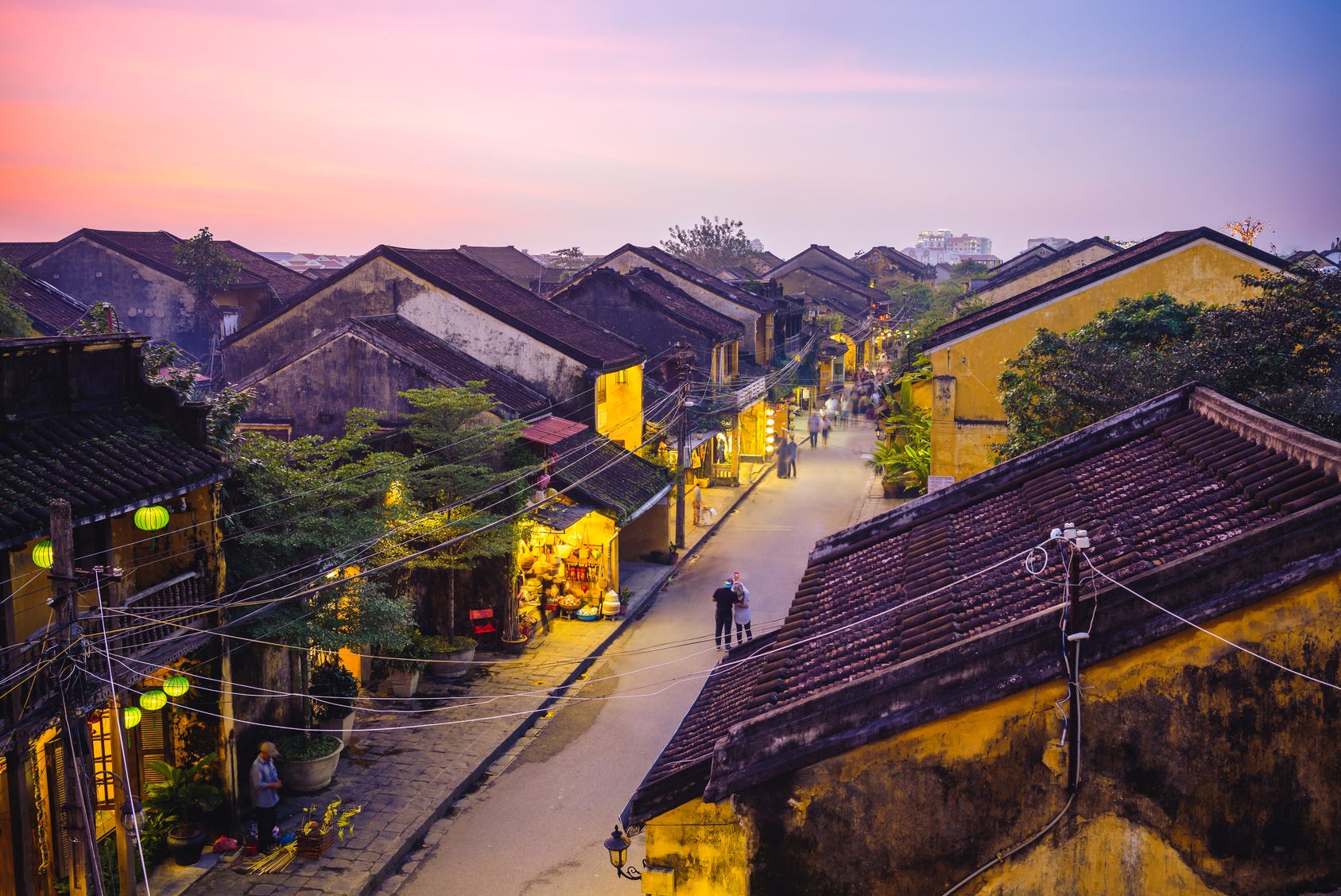
A vivid life, lightly held
Coffee on a low stool at seven in the morning, before the heat, with the city already awake around you. A walk along the river in the old town while the lanterns come on. A bowl of soup at a stall you could find blindfolded by the second week. A long beach on the central coast, a mountain town where you need a sweater at night, and a flight to almost anywhere in Asia from an airport twenty minutes away.
That's the wish people bring to Vietnam: a life that feels more awake than the one at home, at a cost that leaves room to breathe, in a country where you can walk home at night without a second thought.
As one reader put it, "Leaving the US 3 months ago was among the best decisions I've ever made." Three months also happens to be the longest stay Vietnam gives an American on arrival, and it shapes almost everything in this report.
What I'd check first if this were my household isn't the neighborhood or the weather. It's the door. Vietnam has no retirement visa. There is no passive-income permit and no golden visa. For a household that wants one year-round address, that's a real obstacle.
For a household that wants a second base, it may not be an obstacle at all. A life in Vietnam three months at a time, a season or two a year, is a plan the rules support well. And for those who want more, there are two real ways to stay longer, through family or through a business, each with its own price. All of it can be done in the right order.
The life
Where Americans actually land. Most settle in one of four kinds of place. Ho Chi Minh City, the country's commercial engine, where Thao Dien by the river has the international schools, the hospitals and the brunch. Hanoi, older and greener, where many foreigners live around West Lake. The central coast, Da Nang and Hoi An above all, for beaches, a smaller scale and an international airport close by. And the highlands around Da Lat for people who want cool nights and pine trees in the tropics.
A good week. Picture a couple in their sixties in a serviced apartment in Da Nang from January to March, before the heat and well clear of the autumn storms. He'd swim most mornings. She'd take a Vietnamese class twice a week and be badly outmatched by the tones, which her teacher would find delightful. Fridays they'd drive down to Hoi An and eat by the river. One weekend a month they'd fly somewhere new in the region, and in March their daughter would come for ten days and not want to leave. In April they'd fly home, and by October they'd be planning the next season.
What it costs. Day to day, in my reading, Vietnam is one of the least expensive places in Asia to live well. The costs that matter are fixed: a serious international health policy, usually the largest line; the flights each stay requires; and, if you become tax resident, an accountant who knows both systems.
Health care. The private hospitals in Ho Chi Minh City and Hanoi are good, with many doctors trained in the US, France, Japan and Korea who speak English or French. Public hospitals are crowded and work mostly in Vietnamese, and care thins out sharply in rural areas. Vietnam's public health insurance is built around employment contracts, and Ho Chi Minh City's social insurance office said in July 2026 that the law doesn't yet let a foreign resident join voluntarily. If you aren't working there, you pay full price or rely on private cover. For anything complex, foreign residents often go to Bangkok or Singapore. Buy a policy that includes medical evacuation, and read that clause twice.
People. Vietnamese are warm, curious and quick to laugh, and Americans are generally made to feel welcome. English is common in the cities, in tourism and among younger people, and much rarer in government offices. The expatriate communities in Thao Dien, West Lake and Da Nang are large and easy to join, so the first season is rarely lonely. Learn twenty phrases and use them badly; it earns enormous goodwill. You'll be a welcome guest for a long time, and the law keeps it that way: Vietnam is generous with visits and careful with permanence.
The verdict
Where Vietnam stands: a safe, fast-growing one-party state that is easy to visit and hard to settle in. It works beautifully for a part-year life and poorly for a full-time retirement. Current as of November 13, 2026.
What works. Vietnam ranks 41st of 163 countries for peacefulness, where the United States ranks 134th. The economy is growing fast. A season's entry takes an online application and a small fee. The leadership is settled: since April 2026, To Lam has held both the party's top post and the presidency. Since September 11, 2026, American documents need only an apostille.
What doesn't. The door, first: no retirement visa, no path from investment to permanence, and permanence open mainly to people with Vietnamese family. Foreigners can't own land and own homes only for a fixed term. Public health insurance has no place yet for a foreigner who isn't working. And inflation averaged 4.52% in the first nine months of 2026, passing 5% in September: near-term pressure, not a structural problem.
Civil liberties, in proportion. Vietnam is not a free country and doesn't claim to be. Freedom House scores it 20 of 100, Not Free, against 33 for Thailand and 81 for the United States, and it ranks 174th of 180 for press freedom. One-party rule is the decades-old baseline; what's newer is what Freedom House calls "one of the most severe crackdowns on dissent in decades." It falls mainly on Vietnamese journalists and activists; foreign residents who stay out of Vietnamese politics are, in my reading, left alone. The law still reaches them: Britain's travel advice warns that criticizing the government can bring an exit ban or prison, and urges people of Vietnamese descent to take particular care online. The way through: while you live there, keep commentary on Vietnam's government off your social media and stay away from protests. Same-sex couples have no legal recognition; abortion is available on request.
Who it fits. The part-year household that wants one or two seasons a year in Asia and keeps its main home elsewhere. Households with a Vietnamese spouse or a Vietnamese-born parent, for whom the family route leads to permanence. And the entrepreneur ready to put real capital into a Vietnamese company and run it.
Who it doesn't. The retiree who wants a single year-round home abroad without running a business. Same-sex couples who need their marriage recognized. Anyone who wants to write or speak publicly about Vietnam's government while living there. Anyone whose plan depends on owning a house on its own land.
The bottom line: Vietnam is a superb second base on a three-month rhythm and a difficult first home.