


In 2022, eighty-three percent of Canadians called the United States a reliable partner. Today it’s thirty-five. That is not a mood swing. That is a forty-eight-point repricing of the United States, conducted by the people who have to decide whether to build their futures alongside it.
Pew Research Center released its 2026 global image survey today, based on interviews with 42,151 people across 36 countries conducted between February and May.1 I read it the way I used to read assessments that crossed my desk in a different life: not for the headline, but for the trend lines, because the trend lines are where the decisions hide. The headline is that Donald Trump gets negative reviews internationally. Fine. Leaders come and go, and foreign publics have always had opinions about American presidents. That’s not the story.
The story is reliability. And reliability is the one variable that should matter to anyone reading this publication.
What the survey actually found
Start with the topline numbers, because they set the floor. Across all thirty-six countries, a median of twenty-three percent express confidence in Trump to do the right thing in world affairs. A median of 37% hold a favorable view of the United States itself; 57% unfavorable. On the question of whether the U.S. contributes to global peace and stability, thirty-five percent say yes. On whether it considers other countries’ interests when making policy, thirty-two percent.
Those are the composite figures, and composites smooth out the texture. The texture is in the country-by-country movement, and it is brutal.
Favorable views of the United States fell by double digits in the past year in Indonesia, Italy, Nigeria, South Africa, South Korea, and Turkey. In many of the countries Pew has tracked since 2002 — Canada, France, Germany, Italy, the Philippines, South Africa, South Korea, the U.K. — favorability is at or near its lowest recorded level. Mexico was the only country in the survey where views of the U.S. improved.
But favorability is sentiment. Reliability is a forecast. And the reliability collapse is the part that reads like an actuarial table.
The reliability table
Pew last asked whether the U.S. is a reliable partner in 2022, during the Biden administration. Here is what four years did, measured in the countries where the U.S. has its deepest security and economic ties:
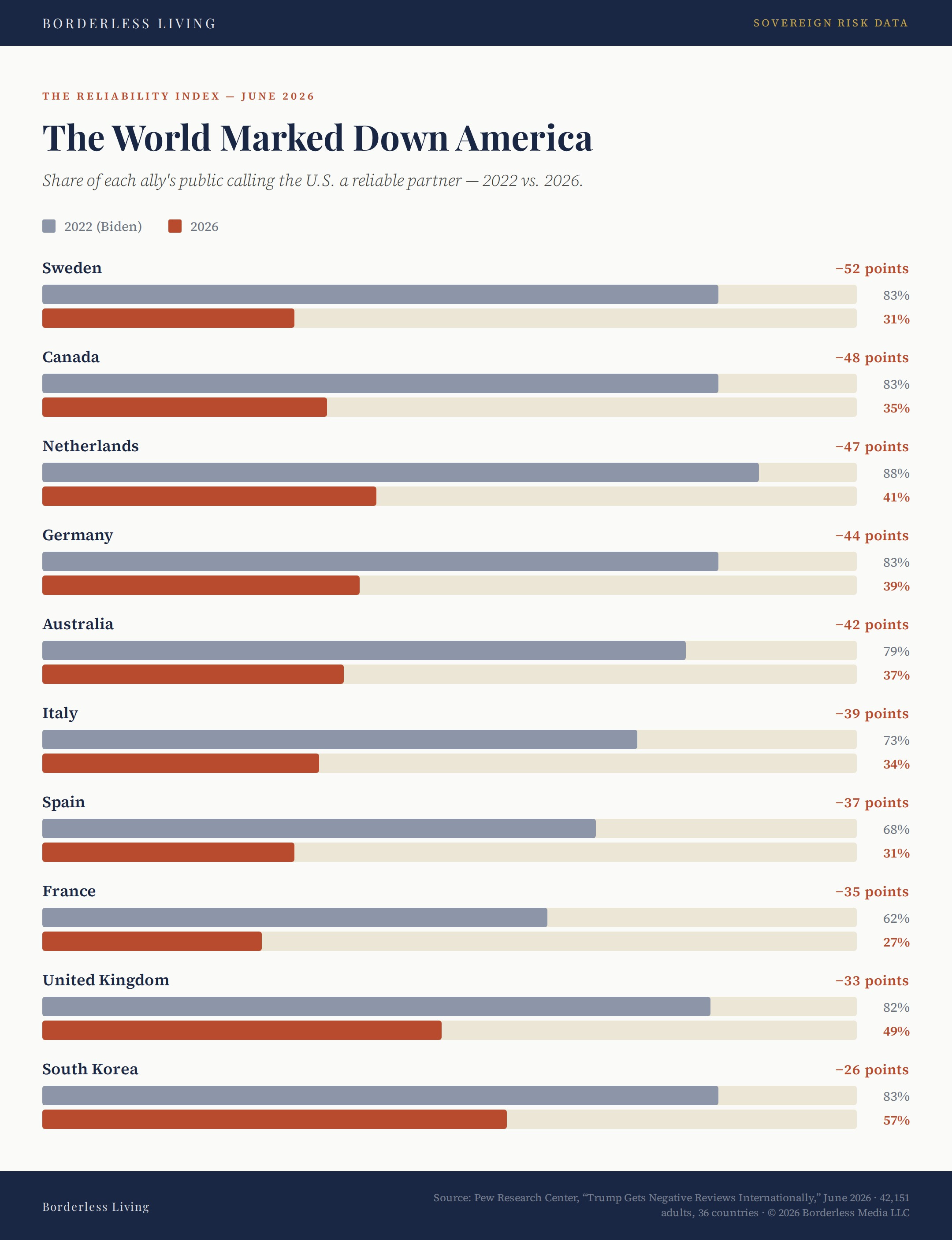
These are not adversaries souring on America. These are the NATO core, the Five Eyes partners, and the Asia-Pacific security architecture. These were, prior to now, staunch, unquestioning US allies. The countries whose populations once assumed that the United States would be there as a baseline condition of the world. That assumption is gone. In eight European nations, the share calling the U.S. reliable fell by 28 to 52 points. Only two European countries — Hungary and Poland — still show a majority. Hungary is the single nation on earth where Americans are seen as more reliable now than in 2022.2
The peace-and-stability numbers move in the same direction. Sweden went from 64% to 23% in three years. The Netherlands, Poland, Canada, and Australia each dropped thirty points or more. And on whether the U.S. respects the personal freedoms of its own people — the democracy question, asked from the outside — a median of fifty-six percent now say it does not. In twelve of the thirteen countries Pew last surveyed on this in 2021, the share saying America respects its citizens’ freedoms fell by double digits. German opinion on whether the U.S. considers others’ interests has fallen to twenty-three percent, lower than it was during the Iraq War.
That’s the briefing.
Now the part that’s actually mine to write.
What a reliability collapse means for you, trying to leave the US
Most coverage of a survey like this treats it as a referendum — a scorecard on an administration, ammunition for one tribe or the other. That framing is a waste of the data. A survey of foreign publics doesn’t tell you who’s right. It tells you what the rest of the world is pricing in. And the rest of the world is pricing in an America that can no longer be taken for granted.
Here is why that touches your life directly. (And this is true even if you’re not planning on leaving the U.S.)
Reliability is the invisible asset behind an American passport. The document is only as good as the proposition behind it — that the issuing country honors its commitments, that its word in a treaty means something, that a partner government will pick up the phone. When foreign publics stop believing that, the erosion shows up slowly and then in specific places: in how your bank abroad treats your accounts, in which countries quietly tighten the screws on American residency applications, in whether the visa-free access you take for granted survives the next round of reciprocal diplomacy. None of that arrives by press release. It arrives as friction. As paperwork that didn’t used to be required. As a door that’s still technically open but heavier than it was.
The reliability number is a leading indicator of that friction. When a country’s population marks the United States down by forty points, the policy follows the sentiment — not immediately, but reliably, on the lag that democracies always run between mood and law.
And this is the trap in the most comfortable assumption Americans make: I’ll deal with it if it gets bad. The reliability collapse is precisely what closes the “if it gets bad” window before you reach it. Options are abundant and cheap when you don’t need them. They become scarce and expensive exactly when everyone wants them at once. The Pew numbers are the sound of the rest of the world repricing American optionality in real time. You want to transact before the repricing finishes, not after.
On timelines
Let me be specific about the clock, because vague urgency is useless, and I won’t insult you with it.
A reliability collapse of this magnitude doesn’t produce a single deadline. It produces a narrowing — a steady, compounding tightening of the pathways that are currently open. The pathways themselves give you the real timeline.
Residency by descent — the Italian, Irish, Polish, and similar bloodline routes — runs on the slowest clock and the most political risk. These programs are gifts of the issuing state, and issuing states tighten them when domestic politics turn or when application volume spikes. Italy has already demonstrated this. If you have a credible claim, the genealogical and documentary work takes months to years, regardless, which means the binding constraint is your paperwork, not the government’s mood — start now, and you’re racing your own file, not theirs. Wait, and you may be racing a rule change.
Residency by investment or by means — the elective-residence and digital-nomad visas, the threshold-based programs — run faster but are more sensitive to capital controls and reciprocal politics. These can be stood up in months. They can also be repriced or restricted in a single budget cycle. The window here is measured in administrations, not decades.
Naturalization timelines, once you hold residency, are fixed by statute and largely indifferent to sentiment — but the clock only starts when you land. Every year you wait to begin residency adds to the back end of citizenship.
The pattern across all three: the cost of acting is highest in your own procrastination, and the cost of waiting is set by people in other countries who have just told a pollster they no longer trust yours. The reliability table isn’t a reason to panic. It’s a reason to move the genealogist’s retainer, the consular appointment, the residency consultation out of the “someday” column and into this quarter. Optionality you’ve already built is insulation. Optionality you’re still planning is exposure.
States hedge. Firms hedge. Capital hedges against exactly this kind of repricing early, while the hedge is still cheap. The Pew survey is thirty-six countries’ worth of evidence that the repricing is underway.
The only question it leaves you is whether your latency is shorter than the system’s.
Pew Research Center, “Trump Gets Negative Reviews Internationally as Fewer Say U.S. Is a Reliable Partner,” June 2026. Survey of 42,151 adults across 36 countries, conducted February 8–May 13, 2026.
Until last May, Hungary was led by Viktor Orbán. It’s now led by Péter Magyar. In part, Magyar’s election was a consequence of Orbán’s authoritarianism and his orientation and relationship with Donald Trump, the Trump family, and the United States. Orbán attacked Obama and Biden, while thrice endorsing Donald Trump (somehow I forgot there was a Hungarian primary/caucus in the RNC nomination process), for President.
And that's why I'm working on my Canadian Citizenship by Descent. I want an escape hatch.
Fascinating. Its clear that we are in the era of multi polarity. The toxic US hegemony has never bern healthy or sustainable.