


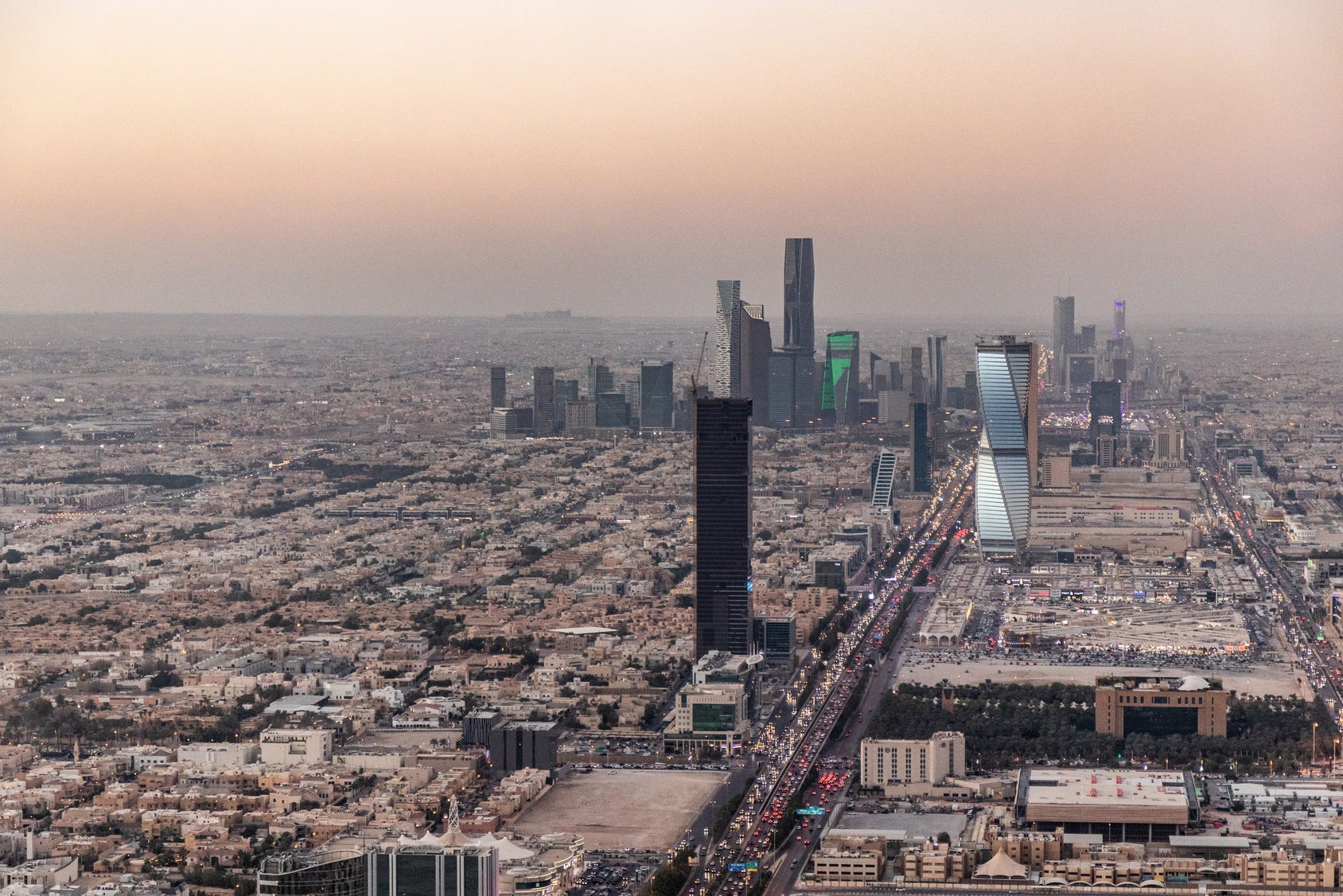
A front-row seat to a country rebuilding itself
A villa with a pool you actually use from October to April. A Friday drive out to the desert for a long lunch under the stars. A city where cranes fill the skyline and new restaurants open faster than you can try them. Work, if you want it, in an economy spending as if the future is due next year. And a residence card that doesn't depend on an employer, so the decision to stay or go is yours.
That's the wish people bring to Saudi Arabia. Not a quiet retirement by the sea, mostly: a base close to the center of the map, in a country changing faster than almost any other, with the comfort money can buy and the door to Europe, Asia and Africa a few hours away. As one reader put it, "Leaving the US 3 months ago was among the best decisions I've ever made." A new base can produce that feeling quickly, when the fit is right.
Saudi Arabia is a real option for a narrower group of households than most countries, and I'll be plain about why. What I'd check first if this were my household is whether we could live comfortably by its rules: an absolute monarchy, a conservative public culture, and laws on speech and personal life that are far stricter than anything an American is used to. The second thing I'd check this year is the regional war. Both have answers. This report gives them, in order, along with the routes, the money and the life on the other side.
The life
Where Americans actually land. Americans mostly land in one of three places. Riyadh, the capital, is where the money, the ministries and most of the new building are; it's the choice for anyone with business in the country. Jeddah, on the Red Sea, is the old trading city, more relaxed and more open to the water, with the coast a short drive away. The Eastern Province around Dhahran and Al Khobar has hosted American families for generations because of the oil industry, and it shows: the schools, the clubs and the expectations are familiar. In all three, many foreigners live in walled compounds with their own pools and social calendars; others rent ordinary villas in town.
A good week. Picture a couple in their late fifties in a rented villa in north Riyadh. He spends three days a week advising a company that is building something enormous, which is part of why they came. She has taken the year to learn enough Arabic to bargain and to read the street signs, and swims every morning before the heat. Thursday night is dinner with friends from Lebanon, India and Texas. Friday is the long lunch out of town. Every few weeks one of them flies to Europe for four days, because from Riyadh it's a short hop, and at Christmas the kids fly in and complain about the heat for exactly one day.
What it costs. Day to day, Saudi Arabia costs less than most big American cities. Food, fuel and electricity are reasonable, and the government sets the price of fuel and utilities, which has kept the cost of living calm even through this year's regional turmoil. Housing is the number that moves: rents in Riyadh rose fast enough that they are now frozen. Budget generously for a good school, if you have children with you, and for health insurance.
Health care. The big cities have modern private hospitals, many with internationally trained doctors. Foreign residents rely on private insurance from a licensed insurer; on Premium Residency you buy your own, and premiums rise with age. Most households keep an international policy as well, with evacuation cover. Specialist care in Riyadh or Jeddah is good; away from the big cities it thins out.
People. Saudis are famously hospitable, and the welcome is real once you're inside it. Public life is conservative, family-centered and religious, and the household that does well respects that without pretending to be something it isn't. English works in business, hospitals and most of daily life in the big cities. Social life runs through compounds, schools, clubs and work, so finding people is easy and Saudi friendships take longer. The households that love it here stopped comparing it with home and started saying yes to invitations.
The verdict
Where Saudi Arabia stands: a wealthy, orderly absolute monarchy that is more open to foreign residents than ever, and this year under fire from a regional war. Current as of November 13, 2026.
What works. The doors. Premium Residency needs no sponsor or employer, and one track is permanent for a single payment. Since January 22, 2026, foreigners can buy property more widely than ever. There is no personal income tax, no inheritance tax and no wealth tax. Prices are calm, with inflation at 1.9% in September 2026, and the riyal is pegged to the dollar.
What doesn't. Two things, one passing and one structural.
The first is security this year. Start with the baseline: Saudi Arabia sits 95th of 163 countries on the Global Peace Index, ahead of the United States at 134th. But since the US-Iran war began in February 2026, Iran and the Houthis in Yemen have fired missiles and drones at Saudi cities, airports and oil facilities; most are intercepted. Fighting with the Houthis flared again in July, and an attack on Riyadh's main airport on October 10, 2026 killed at least 13 people. The State Department advises Americans to reconsider travel (Level 3), and on October 21 ordered non-emergency diplomats and officials' families out. That's outside pressure on a state that is holding, and the reason to plan now and let events set the start date.
The second is structural. Saudi Arabia is not a democracy: Freedom House scores it 9 of 100, Not Free. There are no elections, criticism of the government is prosecuted, and same-sex relations are a crime. Most foreign residents feel those laws in a few places: what you post, who you love, what you pack. For some households they're the whole question.
Who it fits. A household with a working or business reason to be here; a wealthy household that wants a permanent, sponsor-free base in the Gulf; families with oil-industry ties or children working here; part-year residents wintering here.
Who it doesn't. LGBTQ+ households, for whom the law is a real danger. Anyone whose work or habit is public political comment. Households looking for a second passport. And, for now, retirees looking for a quiet, low-risk base while the war continues.
The bottom line: a strong second base for the household that fits its rules, best approached part-year, starting once the attacks on Saudi cities stop.