


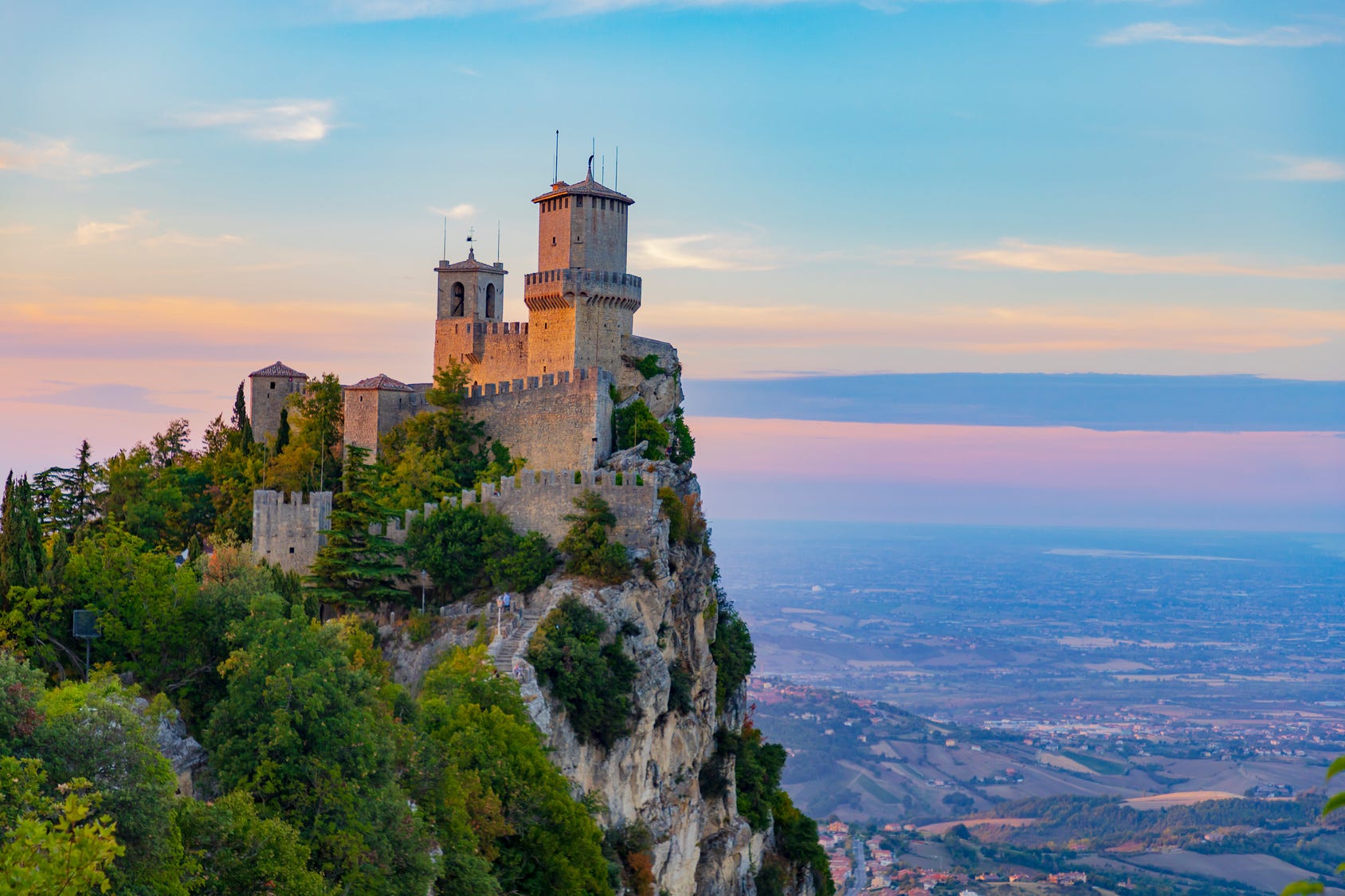
A small republic on a hill
A stone apartment on a green slope, with the Adriatic a pale line on the horizon. Italian on the street and on the table, Italian towns a short drive in every direction, and a front door that belongs to a different, smaller, quieter country. A morning walk up to the old town on the ridge, a long lunch, an afternoon that nobody else has a claim on. A place small enough that a household can be known.
That's the wish people bring to San Marino. It usually arrives with a second thought attached: a tiny independent republic, with its own laws and light taxes on foreign income, must be the clever way to have Italy without Italy's complications.
Part of that is true. San Marino is one of the freest countries in the world, scoring 97 of 100 with Freedom House, where the United States scores 81. For the residents it chooses, it taxes income from abroad lightly. But the doors open to an American who doesn't plan to work here are few, narrow and priced for wealth, and every one of them asks you to actually live on the hill. The clever version of the plan, a San Marino address with an Italian life, is the version that fails.
As one reader put it, "We've read everything and still don't know what to actually do." With San Marino that's no surprise: almost everything written about it is aimed at Italians and other Europeans. This report is written for an American household: what the country offers, which doors exist, what each costs, and the order to do things in.
The life
Where people settle. San Marino is a cluster of small towns on and around one mountain. Newcomers tend to choose between the historic town on the ridge, with the views, the stone streets and the summer visitors, and the quieter towns on the lower slopes, with easier parking, newer apartments and a shorter drive to the Italian coast and the motorway.
A good week. Picture an imagined couple in their late sixties, renting on the lower slopes. Monday would be the Italian lesson, because the language is the whole game here. Tuesday they'd drive down to the coast for fish and a walk on the long beaches. Thursday would be the market in an Italian town across the line, with no border post on the way. Most evenings they'd eat at the same two places, until the owners stopped bringing the English menu. Their daughter and the grandchildren would fly into an Italian airport in June and spend two weeks discovering that a country can fit on a hill. Their American life would still be there, with its house, its friends and its doctors, because they kept it in the plan.
What it costs. San Marino is expensive to enter and reasonable to live in. The entry price is set by the routes, not the shops: the main tax regime for newcomers has a floor of €10,000 a year whatever your income, and the investor route starts at a €500,000 home. Day to day, groceries, restaurants and services feel much like the surrounding Italian region. Housing is the swing cost, because the market is small and the supply of good apartments is thin. Budget, too, for the paperwork: sworn translations of every document, and a local accountant for the first returns.
Health care. San Marino runs its own social security institute, the ISS, and its own State Hospital. New residents pay their own way. On the investor route the law requires private insurance covering every risk. On the two tax-regime routes you cover your health care on terms the ISS sets, and once you're registered as a resident, the ISS assigns you a family doctor and explains what you'll contribute. Most households will also want a private policy that reaches the larger Italian hospitals nearby for specialist care.
People. Sammarinesi are courteous, proud of their republic's long independence, and private. A newcomer earns a place slowly: through the language, the same café every morning, and showing up. Italian matters more here than almost anywhere in Europe: there is no large English-speaking community to fall back on, and Italian at B1 level is now a formal requirement for citizenship. The households that settle happily treat that as the first project, not the last.
The verdict
Where San Marino stands: a free, safe and steady small democracy with a very narrow door for an American who doesn't plan to work. Current as of November 13, 2026.
What works. The country itself. San Marino scores 97 of 100 with Freedom House. For residents it accepts, the arithmetic is generous: a flat 7% on income from abroad, with a floor of €10,000 and a ceiling of €100,000 a year, for up to 15 years. Inheritance tax reaches only what you own inside San Marino. A law of February 25, 2026 ended the rule that new citizens give up their old nationality. The EU signed an association agreement with San Marino on October 19, 2026.
What doesn't. The doors. Every route a non-working American can use is capped, discretionary and expensive; decisions on the three main routes can't be appealed; each takes ten years to settle. Citizenship takes 20. There is no US tax treaty, and San Marino's tax on US pensions and dividends mostly can't be credited on your US return, so it's a cost on top. The country sits outside Schengen but is reached only through Italy, with no border control between them, so plan as if every day there counts toward Europe's 90 days. The banking system is small, and a parliamentary inquiry opened in July 2026 into a foreign group's attempted purchase of one of its banks.
On rights, a free country with gaps worth knowing: same-sex couples can form civil unions but not marry, abortion is legal on request in early pregnancy, and the sexual-violence law is still built on force rather than consent.
Who it fits. A wealthy, retired or financially independent couple who want a small, safe, Italian-speaking home base, will genuinely live there most of the year, and can afford a €500,000 home or a €10,000 annual tax floor without strain.
Who it doesn't. Anyone who needs to work locally, wants a second passport within a decade, wants a part-year base they leave for months at a time, or hopes to use a San Marino address while really living in Italy.
The bottom line: a lovely, free place to live for the few households it fits, and the wrong tool for everyone looking for a shortcut into Europe.