


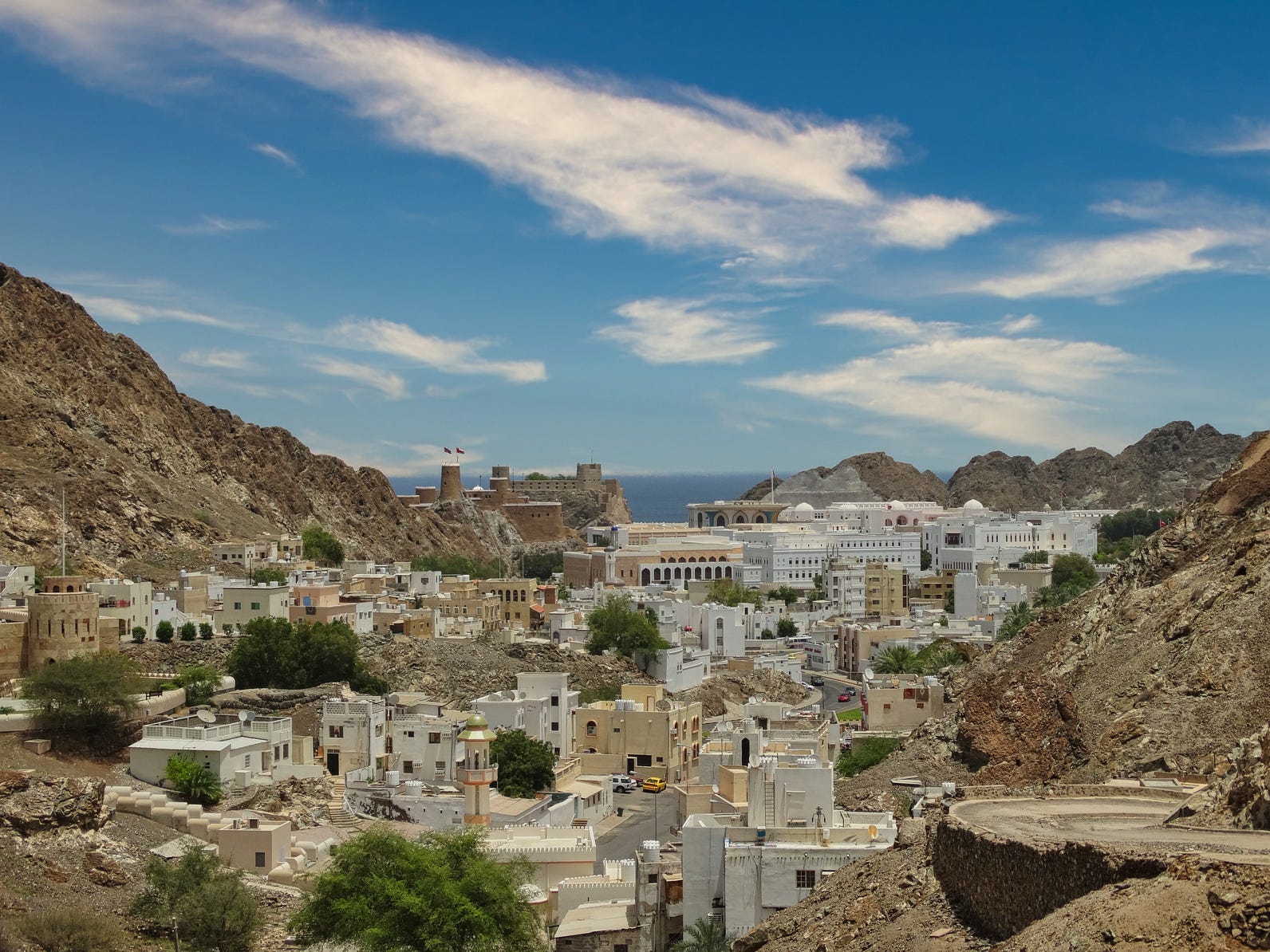
Between the mountains and the sea
A house in Muscat with the mountains behind it and the Gulf of Oman in front. Coffee before the heat, a swim before lunch, the corniche once the sun drops. Neighbors who are courteous and unhurried. Streets that feel safe at any hour. A winter that is the reason you came, and a summer you've learned to spend somewhere else.
That's the wish people bring to Oman: the ease of the Gulf without the glitter, in a country that still looks like itself, with a currency tied to the dollar and, for now, no income tax.
Then the second thought arrives. As one reader put it, "What if we're lonely and broke in the wrong country, missing the grandkids, and then it all goes back to normal here?" In Oman that question has real edges. It's a long way from the grandkids. The rules on speech and private life are not American rules. The US–Iran war reached Oman's ports in 2026. And an income tax arrives in 2028.
What I'd check first if this were my household is whether we were choosing Oman as a second base or as a whole life. As a second base, held through a home or an investment, with the American house kept and the way back open, Oman answers that reader's fear well. If things go back to normal here, nothing about an Omani residence permit stops you coming home. As a whole life, it asks more, because Oman offers long residence but almost never a passport, and its terms are set by a sultan rather than a ballot.
This report is about building the first kind, in the right order. Every hard edge above has a way through, and the life on the other side is a good one.
The life
Where Americans actually land. Most settle in Muscat, the capital, which runs for miles along the coast between the mountains and the sea. Households that want a ready-made community look at the integrated tourism complexes, gated developments such as Al Mouj and Muscat Bay where foreigners have long been able to buy outright. Others rent in older neighborhoods like Qurum and Madinat Sultan Qaboos, closer to the embassies, the international schools and the corniche. A smaller number fall for Salalah in the far south, where the summer monsoon turns the hills green while the rest of the Gulf bakes.
A good week. Picture a couple in their sixties who spend November to April in a townhouse near the marina and the summer back in the States. He has taken up hiking in the wadis with a group that heads out on Fridays; she volunteers at a school library and is slowly, stubbornly learning Arabic. Thursday evening is dinner with friends from Britain, India and Lebanon, because Muscat's foreign community is large, long-established and mixed. Once a winter the grandkids come for the beach and the camels and fly home with stories. Nobody talks politics at dinner, and that's not an accident.
What it costs. The rial is pegged to the dollar, so an American budget doesn't swing with exchange rates. Housing decides most of the bill: a villa in a tourism complex costs far more than a rented apartment in an older neighborhood. Private health insurance climbs with age. Air conditioning runs hard for half the year. Flights home are long and usually connect through the Gulf or Europe.
Health care. Oman's public hospitals are built around Omani citizens. Foreign residents mostly use private hospitals and clinics in Muscat, paid for through private insurance. For a retiree that means two things: a policy that keeps renewing well past 70 and pays for treatment abroad or evacuation for anything complex, and a clear plan for getting care in the US when you're there. Salalah and the interior have thinner private options than the capital. Carry copies of your records and prescriptions; continuity of care is your job, not the system's.
People. Omanis are hospitable and reserved at the same time, and the country runs on courtesy. Foreigners are a large share of the population, so you won't be the only newcomer, but you will be a guest. The rules on dress, alcohol, public behavior and speech are real. The happiest households keep them without resentment, join something early (a hiking club, a church community, a volunteer group) and treat the culture as part of what they came for, not the price of the weather.
The verdict
Where Oman stands: a safe, orderly monarchy that works well for a household willing to live by its rules, with a war next door that hasn't settled. Current as of November 13, 2026.
What works. Safety first: Oman ranks 60th of 163 countries for peacefulness, well ahead of the United States at 134th. The residence routes have just widened: a ten-year Golden Residency relaunched in August 2025, and since June 2026 a foreign property owner can hold residence without a local sponsor. Corruption scores 52 of 100, 54th in the world, against 64 for the United States. And until the end of 2027 there is no personal income tax at all.
What doesn't. Oman is not free in the American sense. Freedom House scores it 24 of 100, Not Free: power sits with the sultan, the courts answer to him, and criticism of the state can be a crime. Same-sex relations are criminalized. Abortion is permitted only to save a woman's life. And from January 1, 2028, residents with income above OMR 42,000 a year (about $109,000) pay 5% on their worldwide income.
The near-term pressure is the US–Iran war. In March 2026, drones struck the ports of Duqm and Salalah, an industrial area at Sohar and tankers off Oman's coast, killing two people at Sohar; drones hit Musandam and Duqm again on July 12. The Strait of Hormuz has not fully reopened, and US travel advice stands at Level 3, reconsider travel. That's pressure from outside on a state that has held, not a slide inside Oman.
Oman fits a household with means that wants a warm, calm, safe winter base, holds residence through a home or an investment, keeps its American house, and is comfortable living quietly within another country's rules.
Oman fits poorly LGBTQ+ households, for whom the law is a real risk; anyone whose work or temperament involves public political comment; households who want a path to a second passport; and grandparents who need to be a short flight from the grandkids year-round.
The bottom line: Oman is a sound winter base for the household it fits, as long as you pick the route that matches your plan, insure your health properly and keep an eye on the strait.