


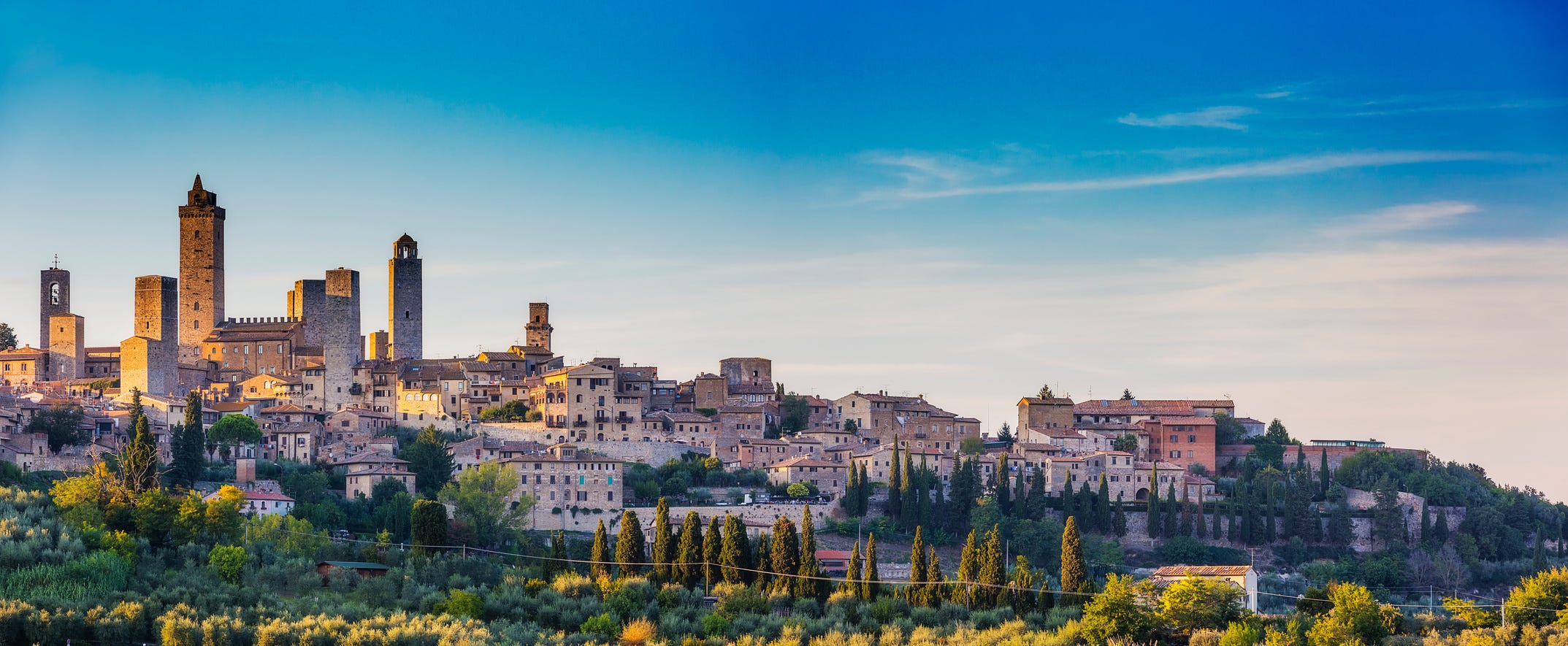
A slower life, on purpose
A rented house outside a town you can walk into. Lunch that takes two hours because nobody is in a hurry. A doctor who knows your name, a market where the woman at the cheese stall starts saving you the good pecorino. Evenings when you realize you haven't checked the news all day.
That's the wish people bring to Italy. Not a vacation that never ends: a slower, richer week, with the people they love able to visit, and the money still where it should be.
I understand the pull better than most. My family goes back to the old country, and Italy is half of the plan my own household is building: two homes, one there and one here. I'd hoped my family's line would carry a passport with it. Italy's 2025 decree put that door on hold for people like me, and I doubt it reopens soon, so we're planning it the way most of you will: as Americans, with the paperwork in the right order.
That last part is what this report is about. Italy is one of the most rewarding places an American household can build a second life, and one of the easiest to get wrong. As one reader put it, "We have money, but not enough to survive a massive mistake." Italy has a handful of mistakes it punishes. All of them can be avoided.
The life
Where Americans actually land. Americans tend to land in one of four kinds of place. Milan and the northern lakes for people who want a real city, good hospitals and fast trains. Rome and Florence for people who want the culture at their door. The countryside of Tuscany, Umbria and Le Marche for people who want the stone farmhouse and are willing to drive. And, increasingly, the south: Puglia, Sicily, Calabria and Sardinia, where the cost of a good life is lower and a new tax regime (below) makes the arithmetic remarkable for retirees.
A good week. Picture a couple in their sixties in a rented house twenty minutes outside a mid-sized town. She writes most mornings. He has a project in the garage that may never be finished, which is the point. Most days they go into town for lunch, partly for the food and mostly to be around people. Thursday is market day. Once a month a friend from the States comes for a week, and in August the grandkids take over the house. Their health care is local and unhurried. Nobody at dinner talks about American politics, because nobody at dinner is American.
What it costs. Italy is not cheap in Milan or Florence and is very reasonable almost everywhere else. The fixed costs that surprise people are bureaucratic rather than daily: the annual fee to join the national health service, the tax filings in two countries, and an accountant you'll be glad you hired.
Health care. Italy's national health service is universal and good, and noticeably stronger in the north and center than in parts of the south. A retiree on a passive-income visa doesn't join automatically: you buy private cover to get the visa, then pay to enroll in the public system each calendar year. Most people keep a private policy too, for speed and for English-speaking specialists.
People. Italians are warm and slow to let you in, which is not a contradiction. The households that are happiest learned the language, joined something (a choir, a walking group, the parish festival committee) and stopped expecting American speed from anything official. Integration, not assimilation, is the test: you can stay American and still belong.
The verdict
Where Italy stands: a stable, free country that works well for the household moving there. It is slipping behind its Western European neighbors on press freedom and LGBTQ+ law, and energy prices are up sharply this year. Current as of November 6, 2026.
What works. Almost everything a household relies on day to day. The passive-income visa and the investor visa are unchanged, and the 7% regime for southern towns just got wider. The national health service is universal and good. Italy is safe, ranking 35th of 163 countries for peacefulness, where the US ranks 134th. It is free, scoring 87 of 100 with Freedom House, six points above the United States. The government is stable and heading to an election due by December 2027. When voters rejected its overhaul of the judiciary in March 2026, 53.7% to 46.3%, the reform died at the ballot box, which is how it's supposed to work.
What doesn't. The bureaucracy, first and always. Services thin out in parts of the south. Inflation jumped to 5.4% in October, led by energy prices pushed up by the war with Iran: a cost-of-living squeeze for 2026 and 2027, not a structural problem.
On civil liberties, Italy is slowly slipping behind its neighbors. It fell from 49th to 56th in world press freedom this year. It ranks 36th of 49 in Europe on LGBTI law, mainly because it offers civil unions rather than marriage. Abortion has been legal since 1978 but is hard to obtain in hospitals where most gynecologists decline to perform it. That's a country falling behind Spain and France, not one heading anywhere frightening.
Italy fits the passive-income household that wants a slower, richer life, values health care and culture over efficiency, and can live with bureaucracy. It's especially strong for retirees willing to live in the south, where the 7% regime changes the arithmetic, and for very wealthy households weighing the flat tax.
Italy fits poorly anyone who needs to work locally on arrival, anyone who can't tolerate paperwork, and households for whom LGBTQ+ legal equality or easy access to reproductive care is non-negotiable.
The bottom line: Italy is a sound second base for the household it fits, as long as the paperwork is done in the right order.