


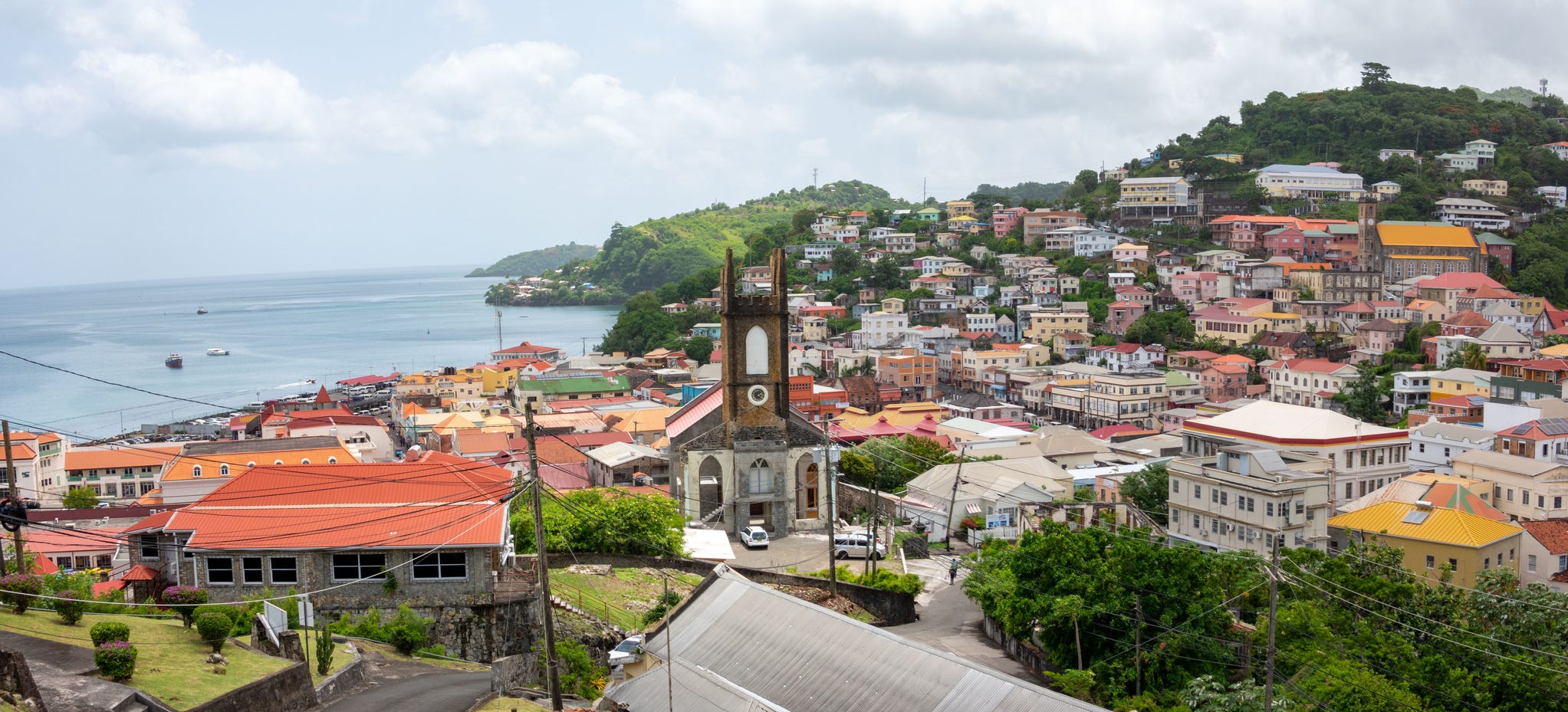
Warm water, and a door that stays open
A house on a hill above a bay, shutters open, the trade wind doing the work an air conditioner would do anywhere else. Fish bought off the boat in the afternoon. A small island where people say good morning and mean it, where English is the language of the courts and the corner shop, and where the week slows to a pace a person can actually live at. And for some, a second passport in the drawer: a door that stays open whatever happens at home.
That's the wish people bring to Grenada. Not an escape, exactly. A second base in warm water, a short flight from family, with the option to stay longer whenever they want to.
Grenada offers both halves of that wish, through two different doors. You can live there as a resident, slowly, the way most second bases are built. Or you can acquire citizenship directly, through a program that has sold passports since 2013 and is now being reshaped by pressure from Washington and Brussels. Many households arrive with the second idea in mind and the first barely considered.
As one reader put it, "We've read everything and still don't know what to actually do." Caribbean passports draw a great deal of marketing, and much of it is written by people who are paid when you buy, so read it with that in mind.
So here is what I'd check first if this were my household: what a Grenadian passport actually does for an American, and what it doesn't. That one answer changes the plan more than anything else in this report.
The life
Where Americans actually land. Most settle in the southwest corner of the main island: Grand Anse, Lance aux Epines, True Blue and the hills around them. That puts them near the capital, St. George's, the airport, the private clinics, and St. George's University, the medical school that keeps a steady stream of Americans on the island. A few choose Carriacou, the sister island to the north: lovelier, slower, further from a hospital, and the island that took the direct hit from Hurricane Beryl in 2024.
A good week. Picture a couple in their sixties who winter in Grenada and summer at home. They rent a hillside house above Lance aux Epines. He swims before the heat comes up; she has joined a group that reads to children at a primary school two mornings a week. Saturday is the market in St. George's, for nutmeg, cocoa, and whatever happens to be ripe. Friday night is fish at a roadside grill with a retired Grenadian teacher, a Canadian couple who live on their sailboat, and a professor from the university. The grandkids come for spring break and refuse to leave the beach. Nobody at dinner is in a hurry, and that turns out to be the point.
What it costs. Grenada runs on the Eastern Caribbean dollar, which is fixed to the US dollar, so your pension buys the same amount in March as it did in January. What grows on the island is cheap; what's shipped in, which is much of the supermarket and most of the hardware store, costs more than at home. Buying is where the real one-time costs sit.
Health care. Routine care is adequate and close by. The public General Hospital in St. George's handles emergencies, and private clinics are generally better equipped, though most want payment up front. Serious or specialist care often means a flight to a larger island or to the US. Medicare usually doesn't pay for care outside the United States, so the households that do well here carry an international health policy with medical evacuation cover, and keep their Medicare for the months at home.
People. Grenadians are warm and direct, and the island is small enough that everyone knows someone who knows you. English makes it easier than almost anywhere else to belong: you can join a church, a hiking group, a sailing club or a school volunteer program in your first month. What it asks in return is patience. Things happen, just not on an American schedule, and the households that relax into that are the ones still there five years later.
The verdict
Where Grenada stands: a free, steady, English-speaking island that works well for a part-year household, with two things to plan around: hurricanes, and a citizenship program now under outside pressure. Current as of November 13, 2026.
What works. Freedom House scores Grenada 89 of 100, Free, eight points above the United States. Voters re-elected the government on November 5, 2026 with 14 of 15 seats, so the rules a resident relies on aren't about to be rewritten. The currency has been fixed to the US dollar since 1976. Grenada taxes residents on income earned in Grenada, not on a US pension or a US portfolio, and it has no capital gains tax and no inheritance tax.
What doesn't. Hurricanes, first: Beryl hit Carriacou as a Category 4 on July 1, 2024 and did about US$218 million in damage, roughly a sixth of a year's output. Health care is fine for everyday needs and thin for serious ones. There is no deposit insurance yet, so local bank balances need to stay modest. Same-sex intimacy is still a crime, with penalties of 10 years to life, and abortion is legal only to preserve a woman's health.
The citizenship program is the moving part. The European Union has asked Grenada and four neighbors to wind their programs down by June 1, 2028, and Grenada is rewriting its own rules to add interviews and a residence requirement. That pressure touches the value of the passport, not the safety of the island or the life of a resident.
Who it fits. The couple with US retirement income who want winters somewhere warm, English-speaking and close; the household that wants a backup passport and understands exactly what it does and doesn't do; the sailor who wants a home port.
Who it doesn't. Anyone who needs specialist care within an hour's drive; same-sex couples for whom legal recognition is non-negotiable; anyone hoping a second passport will lower their US taxes; and anyone who wants a full-time house on the water without a storm plan.
The bottom line: Grenada is a warm, sound second base for the part-year household, and a reasonable insurance policy for the one that wants a second passport, as long as you buy it for what it is.