


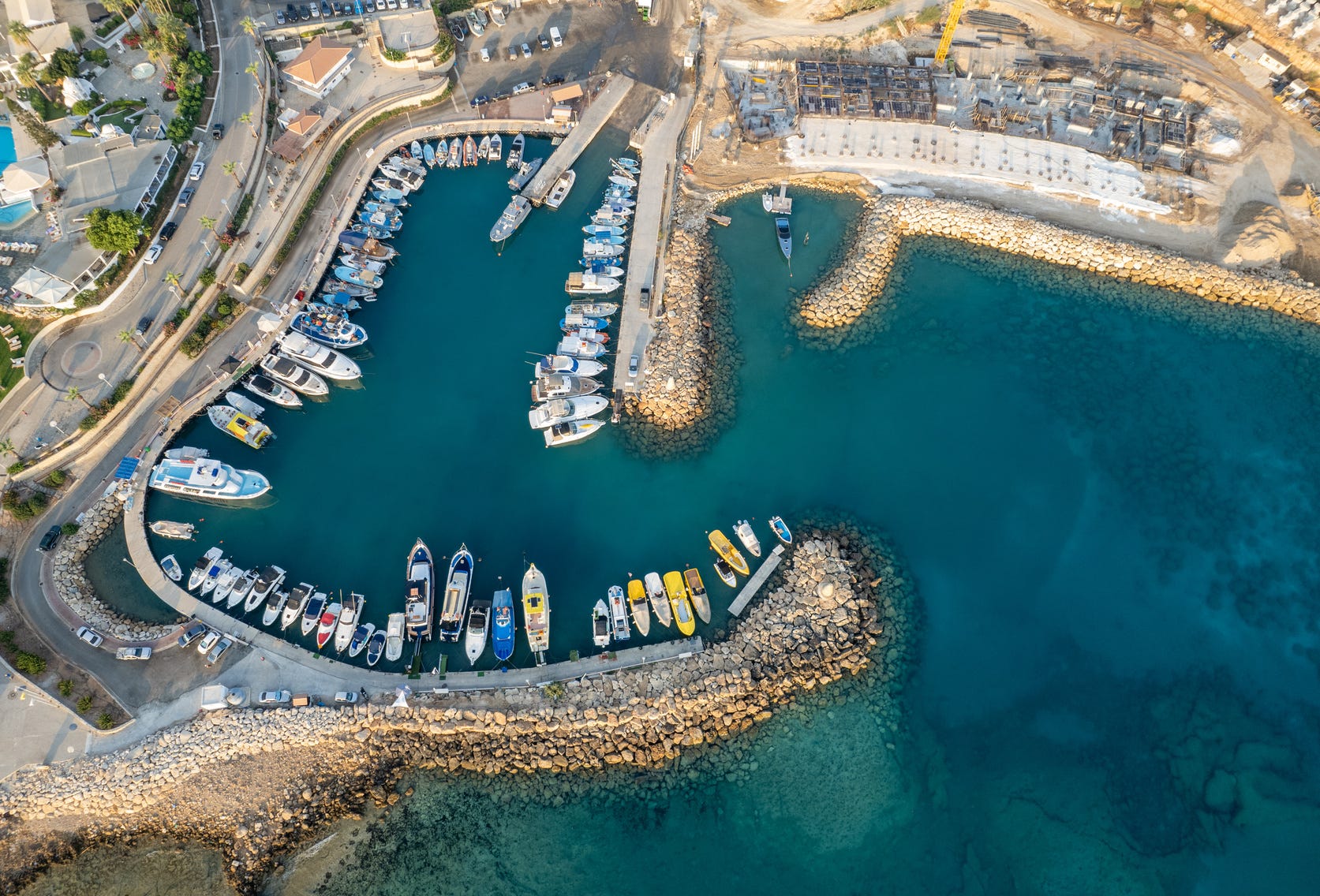
Sun, sea, and a life in English
A flat with a balcony that catches the evening light off the water. A swim in October, because the sea is still warm. Coffee in the square, where the waiter has stopped asking how you take it. A doctor, a pharmacist and a bank manager you can talk to in English, and a tax system that, for a newcomer, is one of the gentlest in Europe.
That's the wish people bring to Cyprus. Not an adventure in a language they'll never master: a Mediterranean life inside the European Union, on the euro, where the street signs are bilingual and the plugs take a British adapter.
If this were my household, the first thing I'd check isn't the beach. It's the permit. Cyprus offers two very different ways for an American household to live there, one built on income and one built on a property purchase, and they lead to very different places. Choose the wrong one and you can spend years in Cyprus without building anything permanent, or spend €300,000 on the wrong kind of house.
That's what this report is about. As one reader put it, "Leaving the US 3 months ago was among the best decisions I've ever made." Decisions like that hold up when the paperwork underneath them is done in the right order. Cyprus has a handful of mistakes it punishes. All of them can be avoided.
The life
Where Americans actually land. Most foreign households settle in one of four places. Limassol is the cosmopolitan one: a seafront city with international schools, good restaurants and the highest rents on the island. Paphos, on the west coast, is where retirees go, with a large English-speaking community and a slower pace. Larnaca is the value choice, close to the main airport, with an old town that still feels lived-in. Nicosia, the capital, is inland and hot in summer, but it's where the government, the university life and the best of the island's food scene sit.
A good week. Picture a couple in their sixties in a rented house on the hill above Paphos. He walks the coast path most mornings before the heat comes up. She has joined a choir that rehearses in English and performs in Greek, which has done more for her Greek than any app. Tuesday is the market. Friday they drive into the hills for lunch at a taverna that serves whatever it has. Once a year the grandkids come for two weeks at Easter, when the island smells of orange blossom, and everyone goes to the beach in water the kids swear is warm.
What it costs. Cyprus is not as cheap as it used to be. Limassol now prices like a southern European city on the rise; Paphos and Larnaca are noticeably more reasonable, and the villages more so. The costs that surprise people are utilities and the paperwork: household electricity prices went up again in November 2026, air conditioning is not optional from June to September, and you'll want an accountant who knows both tax systems.
Health care. Cyprus has a national health system, known as GeSY, with a personal doctor at no charge per visit and small co-payments elsewhere, capped at €150 a year for most people. Which permit you hold decides whether you're in it. Permanent residents living on the island and people working in Cyprus can join; holders of a visitor permit generally can't, and rely on private insurance, which every permit requires anyway.
People. English works almost everywhere, a legacy of British rule, and that makes the first year easier here than almost anywhere else in the Mediterranean. The households that are happiest learn some Greek, join something that isn't organized by other foreigners, and accept that "tomorrow" is a flexible word in any government office. Cypriots are hospitable and family-minded; they're slower to let you all the way in, which is not a contradiction.
The verdict
Where Cyprus stands: a free, stable EU country that works well for a household living on its own income, with slow courts and a press freedom record that has slipped behind most of Europe. Current as of November 13, 2026.
What works. Cyprus is free, scoring 90 of 100 with Freedom House, nine points above the United States, and more peaceful: 80th of 163 countries on the Global Peace Index, where the US is 134th. Both residence routes an American household would use are steady, and the tax overhaul that took effect on January 1, 2026 lowered income tax and kept the regime that draws newcomers. There is no inheritance tax.
What doesn't. The courts, first. Cyprus's rule of law rates slightly above America's overall, but on delay in civil cases it scores lowest of the 31 European and North American countries the World Justice Project groups together. Property paperwork, title deeds included, can be slow, and banks are cautious with American customers. Summers are long and hot, water is scarce, and electricity keeps getting dearer: a cost pressure, not a structural problem. And the island sits close to the Middle East: on March 1, 2026, a drone hit the British air base at Akrotiri, causing minor damage and no casualties. Worth knowing where the bases are; not a reason to stay away.
On civil liberties, Cyprus is a free democracy with one weak spot. It ranks 80th of 180 countries for press freedom, down from 77th and below the United States at 64th. Same-sex couples can form civil unions but not marry; abortion is legal on request up to 12 weeks. V-Dem, the democracy research institute, still ranks Cyprus a liberal democracy, well ahead of the United States, while keeping it on its watchlist of possible backsliders for a second year. That's a country to keep an eye on, not one heading anywhere frightening.
Cyprus fits the passive-income household that wants sun, English and the EU; the retiree who wants a light, predictable tax bill on pensions and investments; and the wealthier household that wants permanent residence without living there full time.
Cyprus fits poorly anyone who needs to work locally on arrival; anyone for whom a quick, reliable court system is essential; households for whom same-sex marriage is non-negotiable; and anyone who wilts in the heat.
The bottom line: Cyprus is a sound second base for the household it fits, as long as the permit, the property and the tax position are decided in that order.