


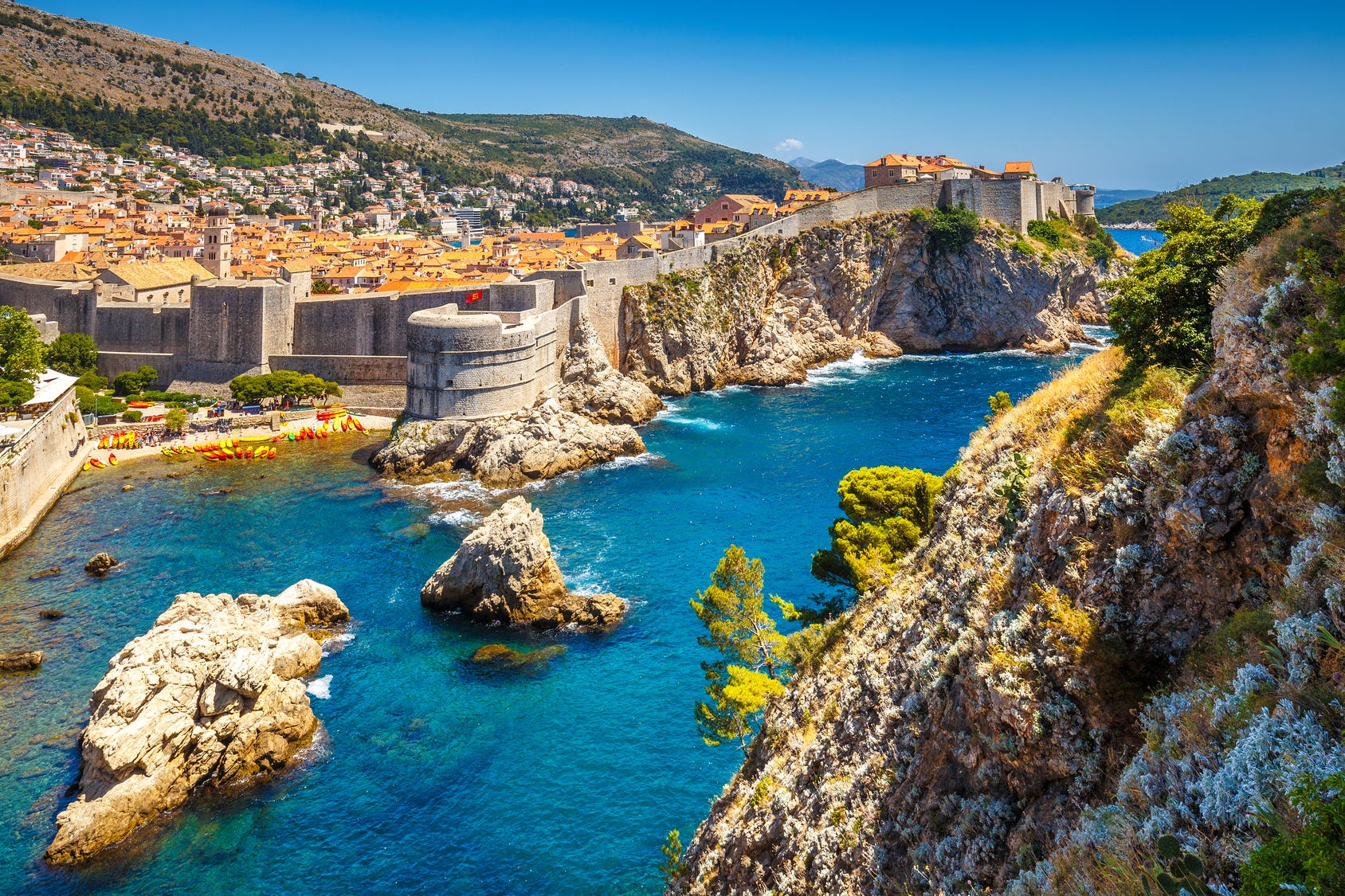
The sea, the stone town, the slower year
A stone house above a harbor, close enough to walk down for coffee. Mornings swimming in water so clear you can count the pebbles on the bottom. A market where the figs come in from the hills and the fish come in by boat. An island ferry that turns into a commute you look forward to. Evenings on a terrace while the light goes gold, then pink, and nobody needs anything from you until tomorrow.
That's the wish people bring to Croatia: the Mediterranean life, in a small, safe European country that feels a little less discovered than its neighbors across the Adriatic, with the rest of Europe a short trip away and room for the people you love to visit.
It is also a wish that draws a particular look at dinner parties back home. "Everyone we know thinks we're crazy." Friends who haven't been often can't quite place it. People who have been understand at once, and tend to ask whether there's a spare room.
If this were my household, the view is not what I'd check first. The door is. Croatia has no retirement visa in the usual sense, and for years that made it a place Americans visited rather than lived. That changed in March 2025, when a new rule opened a real, renewable route for retirees over 60 who own a home there. Families with Croatian roots have one of the more generous citizenship doors in Europe. And there is a tax question to settle early, because the US and Croatia have signed an income tax treaty that is not yet in force.
None of that is a reason to stay away; it's a reason to do the steps in the right order.
The life
Where Americans actually land. Most settle in one of four kinds of place. Split and the Dalmatian coast, for a real town with a harbor, an airport and life all year. Istria, in the northwest, for olive groves, hill towns and an Italian accent to the food. Zagreb, the capital, for people who want a proper city with museums, hospitals and winter that isn't half shut. And the islands, Brač, Hvar, Korčula and Vis among them, for people who want the postcard and accept that the ferry timetable now runs part of their life.
A good week. Picture a couple in their sixties in a stone house ten minutes' walk from a harbor town in Dalmatia. He swims most mornings from May to October, and complains cheerfully about the cold in May. She has joined a walking group that covers the coastal paths on Wednesdays. They shop at the market, eat lunch out twice a week, and in winter, when the tourists are gone and half the restaurants close, they get to know the people who stay. In July the grandkids come for three weeks and spend most of it in the water.
What it costs. Croatia is no longer the bargain it was, and the coast in high summer is priced for visitors. For a sense of local incomes, the average net monthly wage was €1,449 in 2025. Off the coast and out of season, an American household's money goes a good deal further than in Western Europe's big cities.
Health care. Croatia runs a public health system funded through national health insurance. Every residence permit requires health insurance for the whole stay, and a non-EU resident on the retiree's permit must also register with HZZO, the national insurer, and pay contributions. Ask the local HZZO office for the current amount. The large hospitals sit in the cities. An island house is lovely until you need a specialist, so the households that plan well choose a base within reach of Split, Rijeka or Zagreb, and many keep a private international policy as well.
People. Croatians are direct, hospitable and proud of what they have built. English is widely spoken along the coast and among younger people, less so inland and among older neighbors. The households that settle well learn enough Croatian to be polite at the bakery and the town office, show up to the village festival, and treat the quiet winter as the price of admission to the real place. You don't need to become Croatian. You do need to stay long enough for people to notice you came back.
The verdict
Where Croatia stands: a safe, free EU country with a real door for retirees over 60 who buy a home, and no US tax treaty in force yet. Current as of November 13, 2026.
What works. Croatia is one of the more peaceful countries in the world, 23rd of 163, where the United States ranks 134th. It is free: Freedom House scores it 82 of 100, a point above the United States. Since March 15, 2025, a retired American over 60 who owns property there can hold a residence permit that renews and counts toward long-term residence. Families with a Croatian emigrant in the line can claim citizenship with no limit on generations and no language test. And Croatia is cutting tax on pensions: a bill awaiting its final vote in parliament would remove income tax on most pension income from January 1, 2027.
What doesn't. The door is narrow. Under 60, or renting rather than owning, the retiree's permit lasts a year, doesn't renew, and doesn't count toward anything. The US–Croatia income tax treaty was signed on December 7, 2022 but is still waiting on the US Senate, so for now each country taxes under its own rules. Corruption is the institution to watch, at 47 of 100 on Transparency International's index.
On civil liberties, read the trend against the baseline. Croatia is an electoral democracy, rated Free, and ranks 53rd in the world for press freedom, ahead of the United States at 64th. What has moved is direction: the V-Dem Institute's 2026 report lists Croatia among countries that began autocratizing in 2025. That is a slow slide inside a free EU democracy, not a country becoming unsafe. Same-sex couples can form life partnerships but not marry, and abortion is available on request up to 10 weeks.
Who it fits. Retirees over 60 ready to buy a home and live there most of the year. Households with a Croatian parent, grandparent or great-grandparent who emigrated. Remote workers who want up to 18 months on the coast. Part-year households with their main life in the US, if they watch the tax line.
Who it doesn't. Retirees under 60 who want to rent. Households for whom marriage equality is non-negotiable. Anyone with large pension income who needs treaty certainty before they move. Anyone without Croatian roots who wants a second passport: ordinary naturalization means giving up US citizenship.
The bottom line: Croatia is a sound second base for the household that fits its doors, provided the tax side is worked out before the house is bought.