


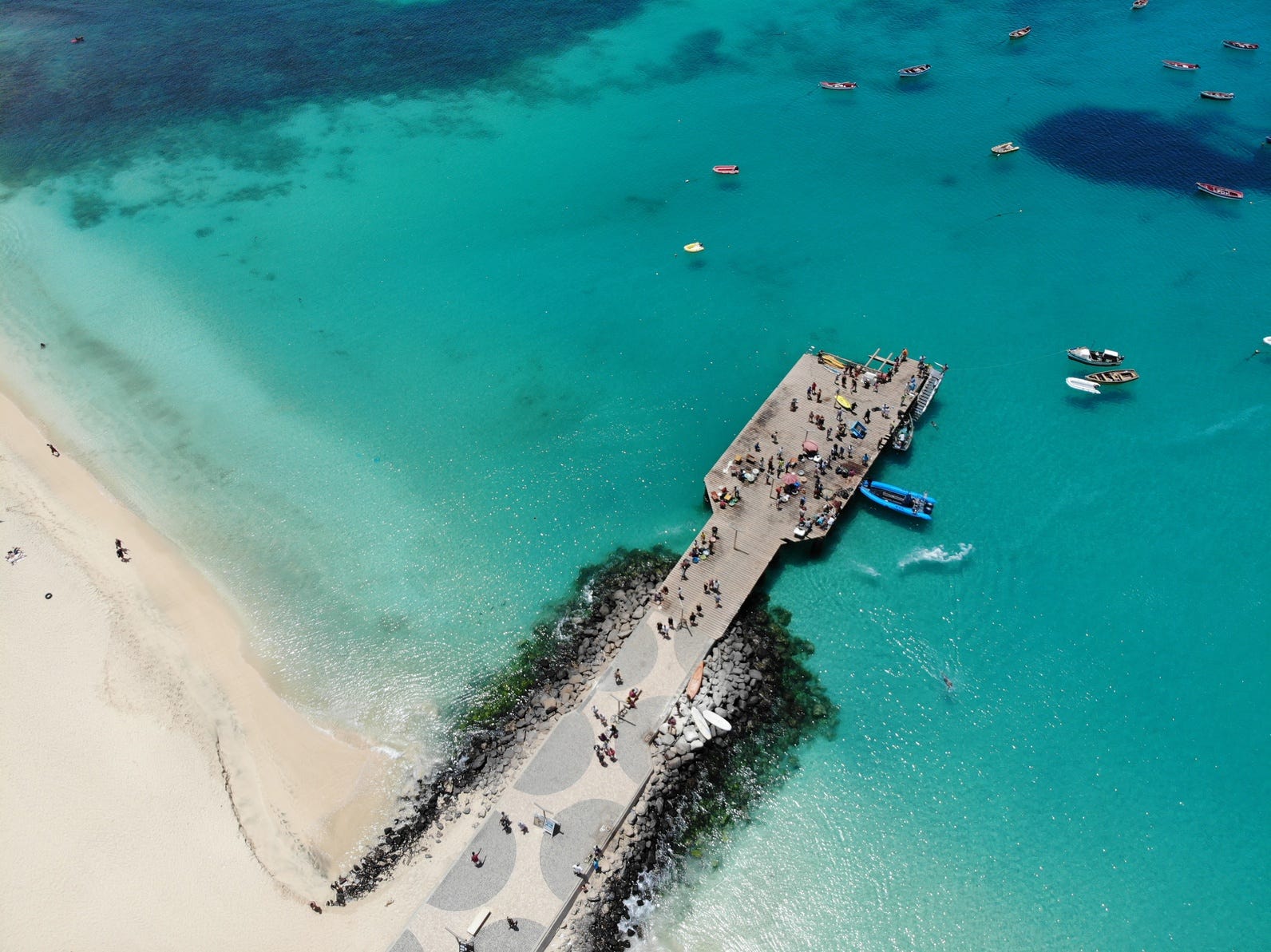
Warm all year, and nobody in a hurry
A small town by the sea where the fishing boats come in before lunch. Warm air every month of the year, with a trade wind that keeps it from getting heavy. Music drifting out of a bar on a Tuesday night for no particular reason. Neighbors who stop to talk, and a week with nothing on the calendar but a swim, the market and a long dinner.
That's the wish people bring to Cabo Verde. Not a resort week stretched out forever: an easy, safe, unhurried life on a set of islands that are proud of their welcome. Cabo Verdeans have a word for it, morabeza, and you feel it within a day of landing.
If this were my household, the beach is not what I'd check first. I'd check three things: where the nearest real hospital is, where the drinking water comes from, and which piece of paperwork turns a long holiday into a residence. Cabo Verde is one of the freest and steadiest democracies in Africa, and it offers permanent residence for the price of a modest apartment. It is also a dry archipelago with thin specialist care. Both are true, and both can be planned for.
As one reader put it, "We've read everything and still don't know what to actually do." For Cabo Verde the answer is shorter than most: choose the island for its hospital and its airport before you choose it for its beach, pick the property route or the income route on purpose, and have the health cover in place before you land. The rest of this report is how.
The life
Where Americans actually land. The islands are not interchangeable, and the choice of island is the biggest decision you'll make. Sal and Boa Vista are the flat, sandy, sunny islands most visitors know: long beaches, resort towns, the busiest international flights. São Vicente is the cultural one, with Mindelo's music, its harbor and one of the country's two big hospitals. Santiago holds the capital, Praia, with the other big hospital, the ministries and the US Embassy. The green, mountainous islands, Santo Antão and Brava above all, are beautiful and quiet, and neither has a working airport. Many Americans who come have family roots on the islands; the Cabo Verdean community in New England is large enough that the country keeps a consulate general in Boston.
A good week. Picture a couple in their late sixties in a rented apartment in Mindelo, a short walk from the bay. Most mornings he swims and she reads on the balcony while the town wakes up. They shop at the fish market and the covered produce market, and lunch is the main meal. Two evenings a week there's live music somewhere within ten minutes' walk. Every winter the grandkids come for two weeks and spend all of it in the water. Their doctor is a private clinic in town, their hospital is fifteen minutes away, and their insurance has an evacuation clause they hope never to use.
What it costs. Everyday life costs less than in most American cities if you eat local and live in town. What costs more is anything that has to be shipped or powered: imported groceries, electricity, air conditioning and water. The islands run largely on imported fuel and make most of their drinking water by desalination. The escudo is pegged to the euro, so budget in euros.
Health care. This is the honest limit. Medical facilities are limited and some medicines are in short supply; the two largest hospitals are in Praia and Mindelo. Ambulances are unreliable in many areas, and moving a patient between islands is not simple. For serious cases, people go to Lisbon. Medicare doesn't work abroad, most providers want cash, and the US government strongly recommends insurance that covers medical evacuation. The good news is real too: the World Health Organization has certified Cabo Verde malaria-free, and for a healthy household, routine care in town is unhurried and personal.
People. Portuguese is the official language and Kriolu is what you'll hear in the street; English goes a long way in the resort towns and less far elsewhere. Cabo Verdeans are open, curious and used to people coming and going, since so many of their own families live abroad. The households who are happiest learn enough Portuguese to handle the pharmacy and the town hall, pick one island and stay long enough to be recognized, and stop expecting a big-city pace from a country of islands.
The verdict
Where Cabo Verde stands: a stable, free island democracy that works well for a healthy household with an evacuation plan, where water and specialist care are the limits to plan around. Current as of November 13, 2026.
What works. The politics, first. Freedom House scores Cabo Verde 92 of 100, above the United States, and in May 2026 the voters handed power to the opposition without drama. A presidential election was held on November 15, 2026, with a runoff to follow if no candidate won a majority. The escudo is pegged to the euro under an agreement with Portugal, inflation is low, and the economy is growing fast on tourism. The US government's travel advice is to exercise normal precautions, with extra care in Praia. And the property route is one of the most accessible anywhere: permanent residence for buying a home from €80,000.
What doesn't. Health care, above all: good enough for routine needs, thin for anything serious, with Lisbon as the real backstop. Water: the World Bank calls Cabo Verde absolutely water-scarce, and the islands make most of their drinking water from the sea, which keeps it safe to have but expensive to run. Getting between islands takes planning. There is no US tax treaty, so the two tax systems mesh only through each country's own rules.
Cabo Verde fits the healthy retired household on a pension that wants warmth, safety and a small-town pace, and is happy to fly to Lisbon for anything major. It fits especially well for families with Cabo Verdean roots and for households that want a winter base with permanent residence behind it.
It fits poorly a household managing a chronic condition that needs regular specialist care, anyone who needs to be near a large hospital at short notice, same-sex couples who need their partnership legally recognized, and households for whom a European passport is the real goal.
The bottom line: Cabo Verde is a sound, warm second base for the household it fits, as long as the island, the insurance and the paperwork are chosen in that order.