


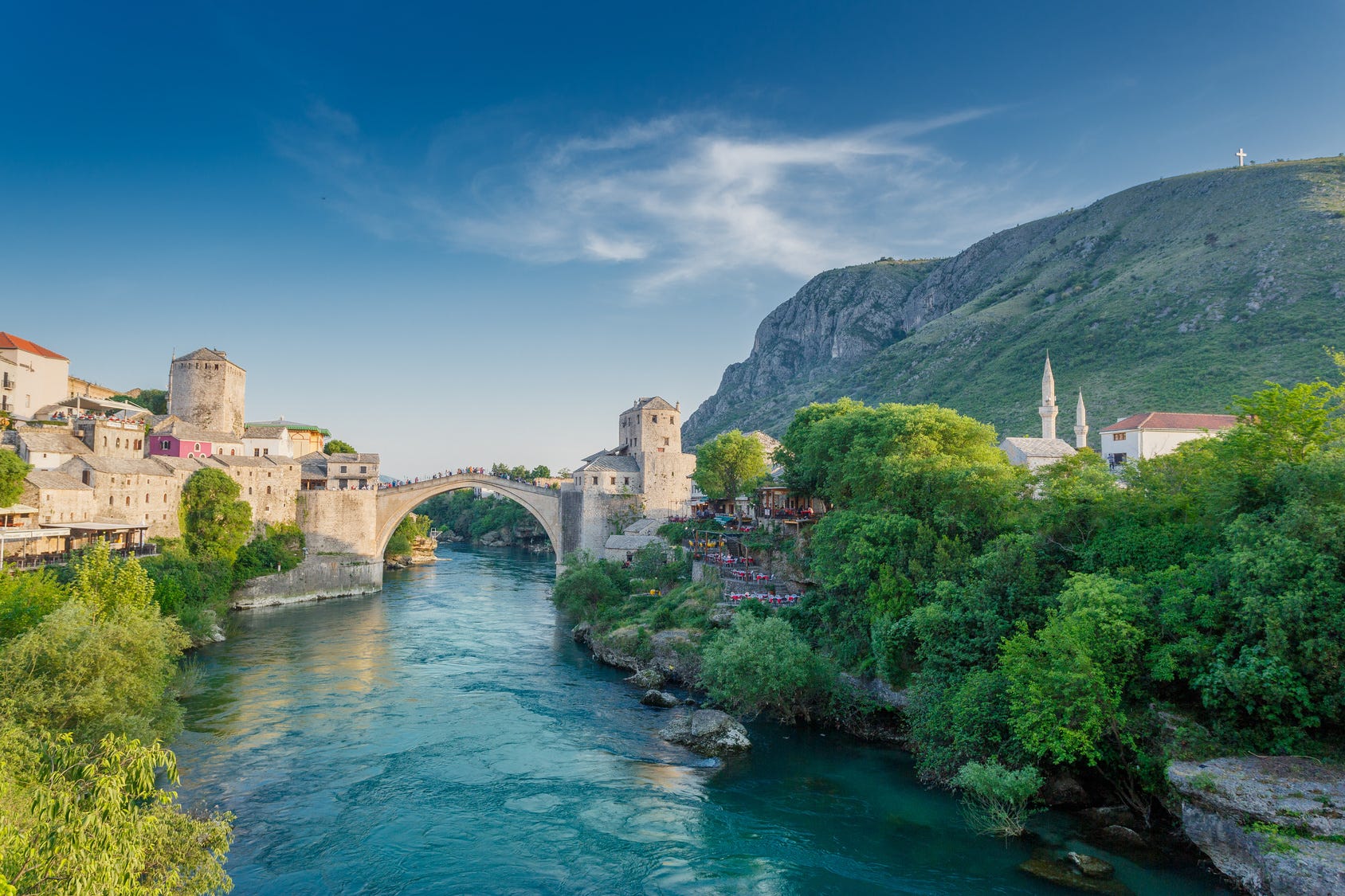
A slower life, off the usual map
A stone house above a river so green it looks painted. Coffee that comes in a copper pot and takes an hour to drink, because that's what it's for. A market where the prices make you check the sign twice. Mountains an hour from the city, the Adriatic a few hours from the door, and neighbors who will feed you before they learn your name.
That's the wish people bring to Bosnia and Herzegovina. Not an escape. A slower, warmer week that costs far less than the same week in most of Western Europe, in a corner of Europe most Americans have only seen on the news.
And that's the catch. Say Bosnia at a dinner party and you can watch the room go back to the 1990s. As one reader put it, "Everyone we know thinks we're crazy." The friends picture the war. The numbers say something closer to the opposite. On the Global Peace Index, Bosnia ranks 48th of 163 countries; the United States ranks 134th.
What I'd want my own household to understand first is that the hard part of Bosnia isn't the street. It's the paperwork. The country has no residence permit built for a retired or non-working American, its government runs on three levels at once, and its tax rules change depending on which side of an internal line you buy a house. None of that is a reason to stay away; all of it is a reason to do things in order.
The life
Where people settle. There are four kinds of place to look. Sarajevo, for the airport, the hospitals, the cafés and the most international crowd. Mostar and the Herzegovina countryside, for a Mediterranean climate, vineyards and the Croatian coast within reach. Banja Luka, the largest city in Republika Srpska, greener and calmer. And the small towns in between, river and mountain places like Jajce, Konjic or Trebinje, where a house with land costs a fraction of its American equivalent and you may be the only American anyone has met.
A good week. Picture a couple in their sixties in a rented house on the edge of a small town. He walks to the bakery for burek while it's still warm; she has taken up the language, badly and happily, with a tutor twice a week. Midweek they drive into Sarajevo for a doctor's appointment and dinner out. On Saturday there's a hike above the river, and on Sunday the neighbors' table, which they have learned not to refuse. In June the grandkids fly into Sarajevo, and the whole family spends a week on the coast a few hours away.
What it costs. Bosnia is one of the least expensive places in Europe to live well. A useful yardstick: the average monthly take-home wage was 1,701 convertible marks (KM) in August 2026, about €870. The mark is pegged to the euro, so a euro-denominated budget holds steady. Prices did rise faster this year, with inflation at 6.0% in September 2026, but from a low base. The costs that catch people aren't at the market: certified translations every year, a local lawyer, and an accountant who knows which tax system you're in.
Health care. Public care runs through entity and cantonal insurance funds built for people who pay in through work. A foreign resident has to show health insurance to get a permit, and the immigration service accepts a private policy or travel health cover as proof. In practice, expect to pay privately, at prices far below American ones, and to use private clinics in Sarajevo, Banja Luka or Mostar for anything routine. Ask any clinic about English-speaking doctors. For serious or specialized care, a plan that also covers treatment in neighboring EU countries is worth pricing.
People. Bosnian, Croatian and Serbian are close enough that one course serves all three, though signs use two alphabets. English is common among younger city dwellers and rare at official counters. Hospitality is immediate; the trick is accepting it. Learn enough of the language to be polite, join something (a hiking club, a language exchange, a congregation) and let the coffee run long. Integration, not assimilation: nobody expects you to stop being American.
The verdict
Where Bosnia stands: a peaceful, inexpensive country with weak institutions and a divided government, where daily life for a foreign resident is steadier than the politics, and residence is the hard part. Current as of November 13, 2026.
What works. Bosnia ranks 48th of 163 countries for peacefulness; the United States ranks 134th. The currency is pegged to the euro under a currency board. Neither of the two main tax systems taxes pensions or dividends. Since November 1, 2026, bank deposits are guaranteed to KM 100,000 per depositor per bank. Americans can stay 90 days in any 180 without a visa, on a count separate from Schengen's, and can generally buy property.
What doesn't. First, there's no residence permit for a retired or non-working American; the routes that exist are discretionary, renewed yearly and built around ties to the country. Second, the institutions. Freedom House scores Bosnia 54 of 100, Partly Free, and V-Dem moved it down a category in 2025, to electoral autocracy, alongside Serbia and Albania. Corruption is the gap you'll feel. Third, the politics. Republika Srpska's leadership has long pushed against the state. In 2025 its president, Milorad Dodik, was convicted of defying the international envoy's decisions and removed from office; the courts' rulings held, and an early election chose a successor from his own party. The October 4, 2026 general election returned the same nationalist parties.
Read that in proportion. These are old tensions in a country whose peace has held since the Dayton agreement, and as far as I can find, none has touched a foreign resident's permit, pension or property title. They make things slower, not dangerous. Inflation, at 6.0% in September 2026, is cyclical pressure from a low base. On civil liberties, plainly: same-sex couples have no legal recognition, and abortion is available on request up to ten weeks.
Bosnia fits the household that wants a low-cost, unhurried base and has, or can build, a real tie: Bosnian heritage, a Bosnian spouse, or property plus an investment. It suits a part-year plan especially well, alongside a base inside the EU.
Bosnia fits poorly anyone who needs a guaranteed retirement visa or a second passport, same-sex couples who need their marriage recognized, and households that want top-tier specialist care close by.
The bottom line: a rewarding second base for the household it fits, and a frustrating one for anyone who assumes a permit follows a house. Settle the route first.