


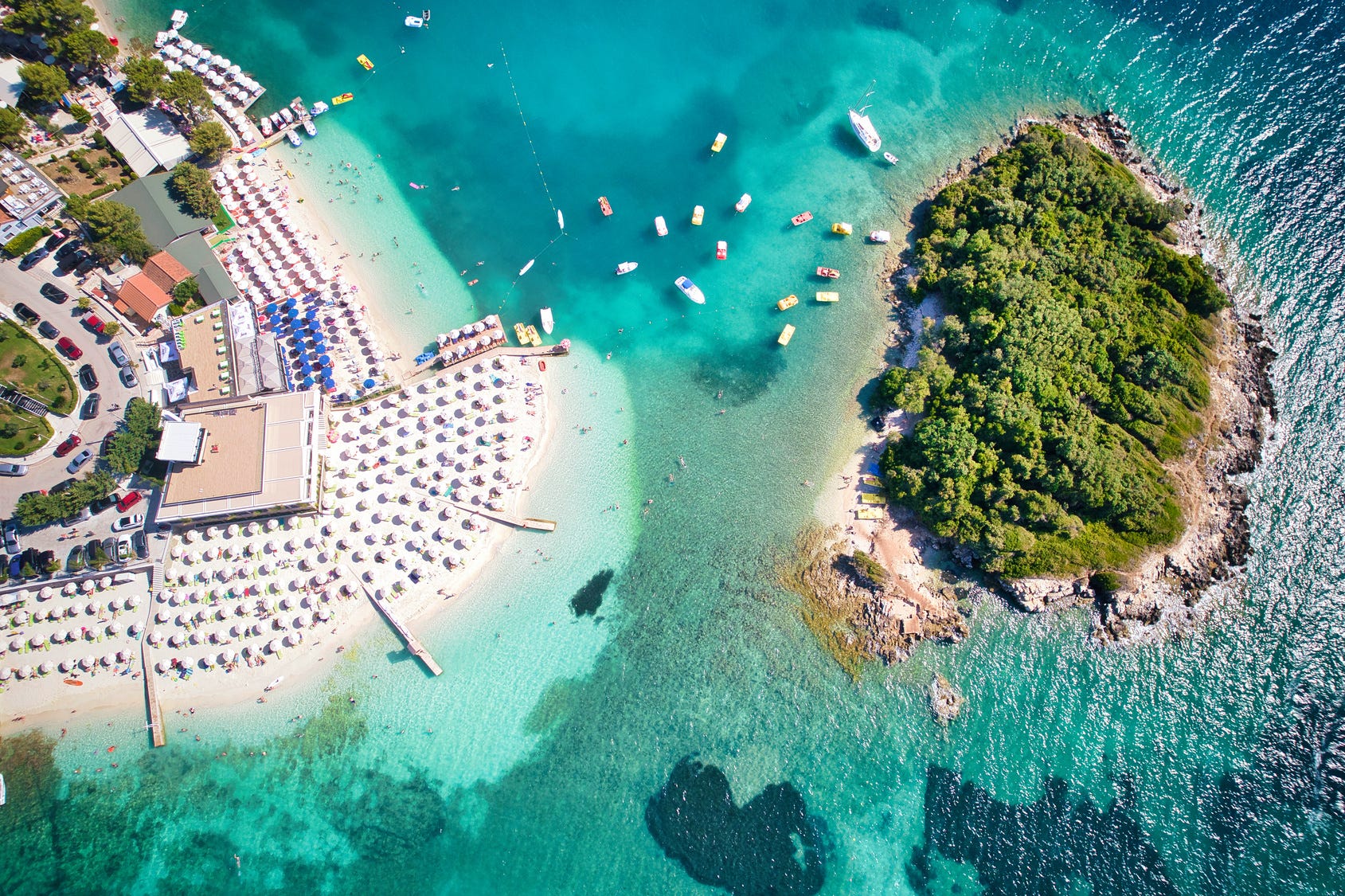
The Mediterranean, with room to breathe
A whitewashed town above the Ionian, the water below so clear you can count the stones on the bottom. Morning coffee on a terrace with the islands on the horizon. An hour inland, a stone town on a hillside where lunch runs long and nobody minds. Mountains behind you, the sea in front, and a monthly budget that leaves room for the grandkids' flights, a car, and a few trips a year.
That's the wish people bring to Albania. Not a bargain for its own sake: the Mediterranean life they've pictured for years, without having to sell the house at home to afford it, in a country that has long been glad to see Americans.
It's also a wish that takes some explaining at dinner parties. As one reader put it, "Everyone we know thinks we're crazy." You're not crazy. Albania is easier for an American to enter than almost anywhere in Europe: you can live there for up to a year without a visa, which means you can try the life before you commit to it. What the people at the dinner party are really asking is whether the rest of it holds: the health care, the taxes, the courts, the ground under a foreign resident.
That's what this report is about. If this were my household, the beach wouldn't be what I'd check first. I'd check three things: how the United States and Albania tax the same retirement income when there's no treaty between them, where the nearest hospital I'd trust is, and which permit turns a year of trying into a life that can last. Albania has a handful of mistakes it punishes. All of them can be avoided, and the life on the other side of them is a very good one.
The life
Where Americans land. Most American households settle in one of four kinds of place. Tirana, the capital, for the cafés, the private hospitals and the airport. The coast near the capital, around Durrës, for the sea with the city a short drive away. The southern Riviera, from Vlorë down through Himarë to Sarandë, for the water and the light, with the trade-off that summer brings the crowds and winter brings the quiet. And the old stone towns inland, Berat and Gjirokastër, for people who want history and hills more than a beach.
A good week. Picture a couple in their early sixties in a rented apartment above the bay in Sarandë. He walks the waterfront every morning and has developed strong views on which bakery makes the best byrek. She takes Albanian lessons twice a week, slowly, and the woman at the fruit stand has decided to help. Midweek they drive up the coast with friends visiting from Ohio. Friday is dinner with two other American couples and the Albanian family downstairs, who have more or less adopted them. Every few months they spend a weekend in Tirana, with a checkup at a private hospital folded in. In July the grandkids arrive, and nobody wants to leave the beach.
What it costs. Albania is one of the least expensive places in Europe to live well, and the difference shows up in daily life: rent, restaurants, help around the house. Tirana and the Riviera in high season cost noticeably more than the rest of the country. The costs that surprise people sit elsewhere: private health insurance with evacuation cover, flights home, and tax advice in two countries.
Health care. This is the part to plan around. The US State Department's current guidance for Albania says public clinics often lack basic supplies, private hospitals usually want payment up front, care in rural areas can fall below American standards, and medical evacuation cover is strongly recommended. Medicare doesn't pay abroad. Foreign residents with a permit can join the public insurance system, but most American households build their care around the private hospitals in Tirana and an international policy that includes evacuation. If you live on the Riviera, know which hospital you'd use and how long the drive is before you ever need it.
Two smaller notes from the same guidance: tap water isn't safe to drink, and Tirana's air can be poor. Neither is a reason not to go; both are reasons to choose your town and season with care.
People. Albanian hospitality is the real thing, and Americans in particular tend to be welcomed warmly. The language takes real work. English is common among younger people in Tirana and the tourist towns, less so in the villages. The households that do best learn enough Albanian to shop and to say thank you properly, join something (a language class, a hiking group, a standing dinner), and treat the slow pace of government offices as part of the deal. Integration, not assimilation, is the test: you can stay American and still belong.
The verdict
Where Albania stands: a peaceful, welcoming country with a dominant government and institutions still being built, about where its Balkan neighbors stand; steady for an American resident, with a season of street protests this fall and a health system you'll want to supplement privately. Current as of November 13, 2026.
What works. The door, first: a visa-free year for Americans, a five-year permit on first application under the 2021 law on foreigners, and pensioner and property-owner permits that are simple by European standards. Tax on investment income is low, and there's no wealth tax. Albania is peaceful, ranking 36th of 163 countries, where the United States ranks 134th. Social Security payments arrive normally. And Albania's bid to join the European Union by 2030 pulls its institutions toward European standards.
What doesn't. There's no US income tax treaty, so nothing settles which country taxes your retirement income first, and Albania's tax break for foreign pensions covers EU citizens, not Americans. Health care outside the private hospitals is thin. And the institutions are weaker than the welcome: Albania ranks 91st of 143 countries on rule of law and scores 39 of 100 on corruption, and Freedom House rates it Partly Free, at 69 of 100.
That last point needs its proportion. Albania sits about where its Western Balkan neighbors do: Montenegro scores 68 with Freedom House, North Macedonia 67, Serbia 53. And the checks are real, if young: the anti-corruption prosecutor arrested Tirana's mayor, long tipped as a future leader of the governing party, in February 2025 and indicted him in July. What has changed is the direction. V-Dem, which tracks democracies worldwide, moved Albania down a category in 2025, to the border between electoral democracy and electoral autocracy. In October 2026 student-led protests over corruption, education costs and a luxury resort on the southern coast turned violent in Tirana, with hundreds charged. The anger is aimed at the government; none of it has reached a residence permit, a pension or a property title. For a foreign resident it's a reason to keep your paperwork clean and current, not a reason to stay away.
Albania fits the household whose income is mostly dividends and gains rather than a large pension, that wants the sea and the mountains on a modest budget, is comfortable building its health care around private hospitals, and would like to try the life for a year before committing. It suits part-year households well, and remote workers who keep their American clients.
Albania fits poorly households with serious ongoing medical needs, anyone whose income is mainly a large US pension or IRA drawdown until the two-country tax arithmetic has been done, anyone who needs strong courts behind a large property purchase, and same-sex couples, whose relationships Albania doesn't recognize at all.
The bottom line: Albania is a real second base for the household it fits, an easy one to try, and one where the order matters more than the view.