


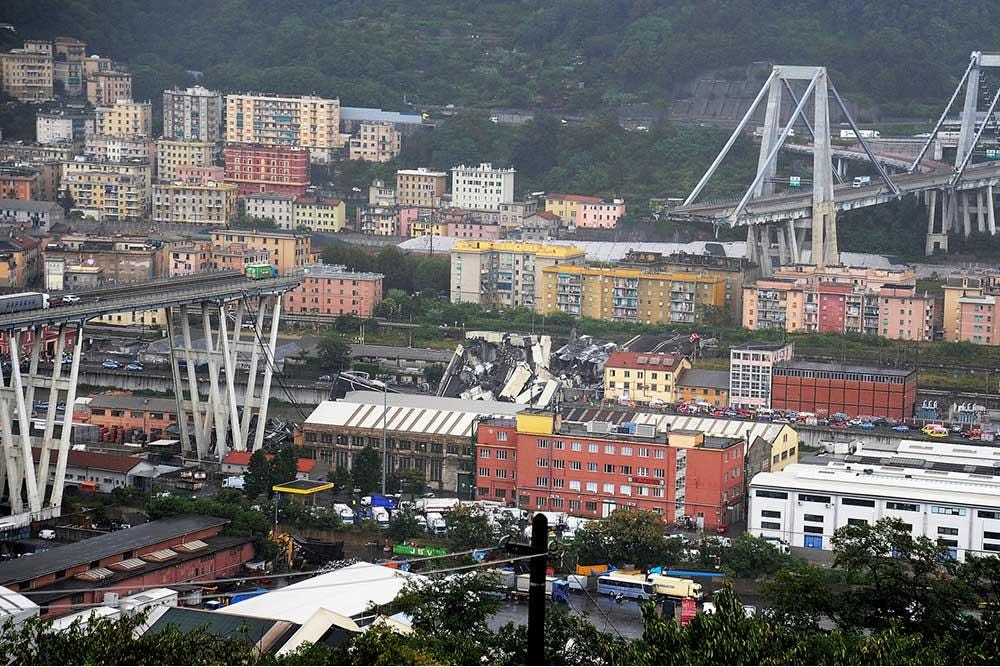
In the summer of 2016, a group of Italian engineers noticed something strange about a bridge.
The bridge looked completely normal. Traffic was still moving. There were no visible signs of stress. But sensors embedded in the structure—installed years earlier as a precaution—were reporting changes that didn’t belong. Stress loads were redistributing. Vibrations were appearing where they hadn’t before.
The bridge was the Morandi Bridge in Genoa.
The problems were not new. As early as the 1980s, engineers had identified corrosion and internal stress in the steel tendons. Sections were retrofitted. Monitoring continued. But degradation persisted through the 2000s. By 2016, inspection data showed continued cable erosion and shrinking safety margins. A major retrofit was planned—but scheduled, not urgent—because the bridge still appeared to function.
Then, in 2018, it collapsed.
A 210-meter section failed during a heavy rainstorm.
Forty-three people were killed.
There was no dramatic warning.
No visible fracture.
No decisive moment.
Just drift.
Then collapse.
Sensitivity to Variance Matters More Than We Admit
Consider how we normally talk about stability.
We ask whether a treaty still exists.
Whether a law is still on the books.
Whether a government is still functional.
Whether a president is still in office.
These are comforting questions. They have clean, binary answers.
They are also the wrong questions.
The question that matters is simpler—and far more uncomfortable:
Does this system still behave as people expect when stress is applied?
When the answer to that question changes, risk has already arrived.
And it changes long before the outcome becomes visible.
Ambiguity Is the Hallmark of Risk
Think about what happens when behavior inside an institution becomes conditional.
Not chaotic.
Not erratic.
Not inexplicable.
Just… conditional.
At first, nothing seems different. The language remains. Institutions still meet. Forms still get filed. Business continues.
But behavior shifts.
Partners hedge.
Markets reprice.
Decision-makers add caveats.
Response times stretch.
That hesitation isn’t noise.
It’s the evolution of risk.
People look for the crack in the bridge.
But by the time the crack appears, the bridge is already failing—or about to.
Political risk does not begin with fracture.
It begins when what was once predictable becomes contingent.
The Same Failure Mode, at Scale
That’s why the most dangerous phase of any system isn’t collapse.
It’s the period after reliability degrades—but before anyone is willing to say so out loud.
Which brings us to NATO and Greenland.
Most commentary still treats NATO as a binary object. Either the alliance exists, or it doesn’t. Either Article V is in force, or it isn’t.
Treaty intact equals deterrence intact.
That framing is obsolete.
What makes NATO's deterrent is not the text of Article V. It is the presumption of automaticity—the shared belief that if a line is crossed, response follows without negotiation, delay, or reinterpretation.
Deterrence depends on predictable behavior, not treaty language. That’s why, in the wake of 9/11, the European countries immediately moved to invoke Article V. The United States didn’t ask them to. The United States effectively didn’t need the world’s help to defend its sovereignty. A flag officer from a European country said to me:
we invoked it because that’s what we do. You were attacked. Our promise was, any of us get attacked, we invoke the treaty. You were attacked. We invoked the treaty. It’s as simple as that.
It is as simple as that.

The Greenland episode isn’t a joke. It isn’t about territory, trade, or diplomacy gone mad.
It is a public demonstration that the United States is willing to apply coercive pressure inside an alliance framework—and to treat allied sovereignty as negotiable rather than assumed.
The United States has broken the chain of predictability. You don’t treat your allies as enemies. You don’t threaten your allies with military conquest. You don’t threaten to ignore their sovereignty.
The treaty still exists. Article V still exists.
But Trump's actions are enough to force NATO members to reprice U.S. guarantees.
Because once an ally is treated as a bargaining counter, the question is no longer “Is the treaty still valid?”
It becomes:
“Under what conditions would it not be honored?”
Regardless of what ultimately happens with Greenland, NATO has already been functionally neutered—not because the treaty was abrogated, but because ambiguity replaced what had once been remarkable clarity.
It’s (unfortunately) as simple as that.
Spillover Isn’t About War. It’s About Friction.
When people hear “credibility decay,” they think in military terms—alliances, deterrence, conflict.
That’s not where the spillover shows up first.
It shows up in movement.
Of people.
Of capital.
Of permissions.
Credibility isn’t just a military asset. It’s the invisible lubricant that allows cross-border systems to function smoothly. When it degrades, nothing breaks all at once. Friction increases everywhere.
For decades, Americans benefited from a quiet assumption embedded in global systems: that U.S. citizens, firms, and capital were stabilizing by default.
That assumption wasn’t written into law.
It lived in behavior.
It showed up as faster visa processing (or no visa requirements at all), routine residency renewals, flexible interpretation of compliance requirements, and informal problem-solving at the margins.
Not privilege.
Predictability.
When commitments become conditional, that predictability erodes downstream. Not dramatically. Incrementally.
No one announces a policy that says, “Americans are now a risk.”
Instead: more documentation. Longer timelines. Stricter interpretation. Fewer exceptions.
Everything still works.
It just works worse.
That’s repricing.
Read the Signals, Not the Headlines
Start with something that feels far away from daily life: gold.
Foreign states have quietly moved to repatriate gold held at the Federal Reserve. There’s no panic in this. The dollar still clears. Markets still function. Treasury bills, bonds, and notes are still being traded.
But things have changed.
Gold that once sat comfortably abroad is being brought home—not because the system is expected to fail, but because counterparty risk is no longer assumed away. Trust hasn’t vanished. It’s been shortened.
These moves are expensive. Tens of millions to transport, assay, remelt, and store.
No one does that casually. You do it when you believe the system will keep working—but only under conditions, not assumptions.
Now look at banking.
Across Europe and elsewhere, U.S. citizens increasingly face higher friction in opening or maintaining accounts. Not hostility. Classification.
High-variance clients are not expelled.
They are handled differently.
Then look at timelines.
Portugal didn’t abolish the program; it narrowed access, tightened conditions, and effectively doubled the timelines for many.
No ban. No speech. Just a longer horizon.
Spain's consideration of similar moves isn’t a coincidence. It’s the same adjustment by a different institution under the same pressure.
Extend the clock. Reduce discretion. Raise the cost of uncertainty.
Finally, look at reciprocity.
When countries respond to perceived travel discrimination with reciprocal measures, they aren’t escalating. They’re normalizing conditionality.
Movement becomes transactional.
Assumptions disappear.
Everything still functions.
Seen separately, each of these developments has a reasonable explanation.
Seen together, they tell a different story.
Timelines lengthen.
Discretion narrows.
Trust horizons shorten.
Across money.
Across movement.
Across permission.
This is what systems do when they no longer believe the future will resemble the recent past.
The sensor isn’t silent.
It’s humming.
And when it hums this consistently, in this many places, that isn’t noise.
It’s a signal.
Never forget: Forty-Three People Died.
Epstein.
The 51st State.
The Nobel Prize.
Greenland.
That’s what most people thought about today.
Not timelines.
Not friction.
Not whether the systems they rely on still behave the way they think they do.
Meanwhile—crack.
Not loudly.
Not dramatically.
Not visibly.
Just enough to matter.
Everyone is staring at the spectacle on the horizon — the fireworks, the shouting, the thing that looks dramatic from a distance — while standing on a structure that is quietly failing beneath their feet.
The danger isn’t where everyone is pointing.
It’s where no one is looking.
By the time this bridge actually cracks, the conversation will finally feel serious.
And by then, it won’t matter.
On Thursday, I’ll translate this pattern into operational posture: how to position mobility, capital, and legal status before friction hardens into constraint—and what I would still delay, even now.
The visa, the apostilles, the background check — those are the easy part. People get all of that right and still end up in trouble. Even people with accountants, lawyers, and wealth managers.
What goes wrong is further back. A decision that looked perfect ten moves ago, arriving now as a tax bill, a letter from a government, a check you didn’t plan to write. And nobody had to do anything wrong. They just never saw the whole board.
A Situation Review takes 25 minutes. It’s free. You’ll leave knowing whether you have a wish or a plan.
As a subscriber to TLM, I really appreciate you leaving this BL post open for all to read. Thank you as always for your clear analysis.
THIS! Is profound. Thank you for connecting these dots and painting a picture most of us can see, understand, and appreciate. Well done! Again, thank you.